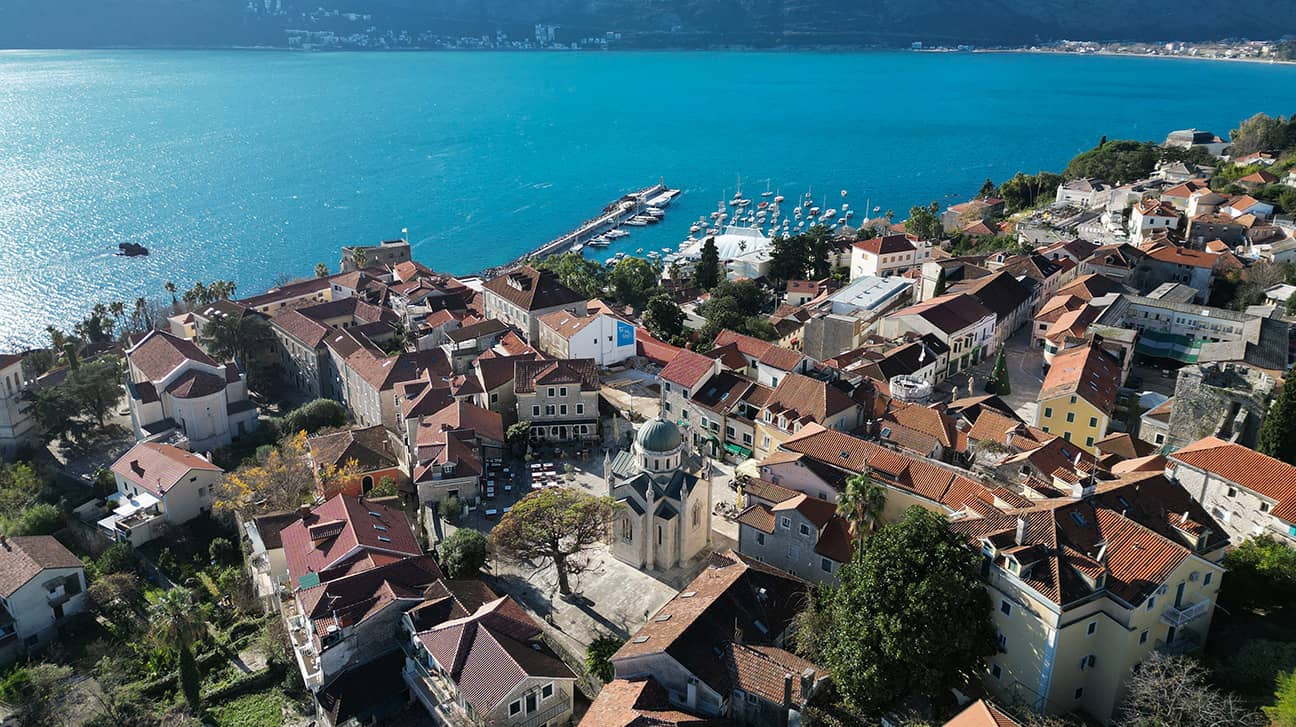
Herceg Novi is a town located at the very beginning of the Bay of Kotor at the foot of the Orjen mountain range, virtually on the border between Croatia and Montenegro. In its six-century history, it has changed hands, has preserved the footprints of various cultures and is today a popular tourist destination.
History of the city's founding
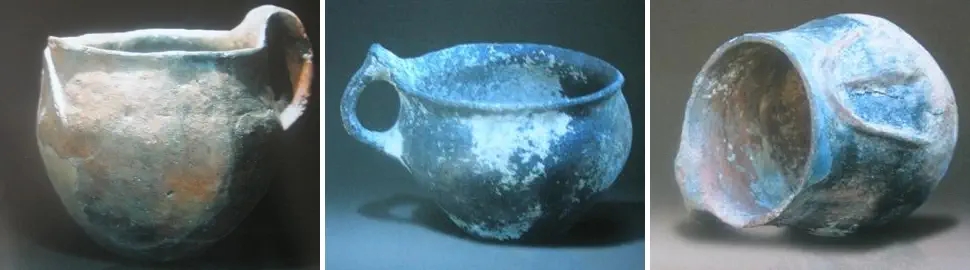
The first settlements on these lands predate the city itself. Archaeological excavations carried out in one of the caves in Orjen, Vranjaj, have helped find vessels dating back to the Neolithic and Early Bronze Age.
Around the third century, after the defeat of the Illyrian tribes, the area fell to the Roman Empire, and later Byzantium gained influence here. By the 7th century, settlements of Slavs appeared in the Western Balkans, who, under Byzantine auspices, began to form independent parish towns. Such a place was also created on the territory of Herceg Novi, called Dračevica.
In the 10th century Dračevica lost its independence and was conquered by the princes of Zeta. Later it changed hands, until finally in 1378 the Bosnian king Tvrtko I Kotromanić decided to occupy the Topla Bay (one of the areas of modern Herceg Novi) and thus resolve the issue of access of the Bosnian kingdom to the sea.
Thus, in 1382, a new town was founded and named Sveti Stefan. King Tvrtko intended the new town to be a centre of crafts and commerce, thus competing with Dubrovnik.
After the king's death, power passed to Sandal Hranjič of the Kosač dynasty. His reign is remembered for the fact that under him the town became an important point for the salt trade, which was one of the most lucrative trades in Medieval Europe.
After Sandal Hranjić, power over the town passed to his nephew Stefan Vukčić. In 1448 he was recognised as Duke (bosnian «Herceg») and then, in honour of this event, the town of Sveti Stefan was given its modern name — Herceg Novi.
During the reign of Stefan Vukčić, Herceg Novi reached its greatest dawn since its foundation. It was a place where weaponry, blacksmithing, shoemaking and jewellery-making were developed, and examples of these are still preserved in the walls of the Savina Monastery.
Later, Stefan died in 1466 and the reign passed to his son Vladislav Hercegović, who became the last Bosnian Christian ruler of Herceg Novi. In 1482 Hersekli Ahmed Pasha conquered the city, which passed under the rule of the Ottoman Empire for the next two centuries.
In the next two centuries, until 1688, with a brief interval of 9 months in the 16th century, Herceg Novi was under the rule of the Ottoman Empire. During this time the city was thoroughly fortified: city walls were erected (which have not survived to this day) and two fortresses were built — Kanli Kula and Španjola.
In 1688, after a 90-day siege, the Italians succeeded in incorporating Herceg Novi into the Venetian Republic as part of the province of Albania-Veneta.
In later years, the fate of the town echoes the fate of the Bay of Kotor, passing from hand to hand:
- from 1797 to 1805 as part of the Habsburg monarchy after the Treaty of Campo Formi;
- from 1806 to 1807 a short protectorate of the Russian Empire;
- 1807 to 1815 — French territory under the Treaty of Tilsit;
- 1815 to 1918 — Austria-Hungary;
- November 1918 to 1941 — part of the Kingdom of Yugoslavia;
- 1941 to 1944 — under the control of the Axis countries;
- 1944 to 2003 — The People's Republic of Montenegro within Yugoslavia;
- from 2003 to 2006 as part of the confederal State Union of Serbia and Montenegro;
- Since 2006, the town and centre of the municipality of the same name in Montenegro.
The Old Town of Herceg Novi: What to see
Herceg Novi is a city where almost all rulers have left their footprints. Although each new owner has tried to rebuild the city to suit himself, this has not prevented it from preserving the memory of all eras.
There are, of course, some historical monuments that have been lost forever. These include, for example, the city walls (which enclosed the city during Ottoman rule and were dismantled during the Austria-Hungary) and the Citadel, which collapsed in a major earthquake in 1979. This doesn't mean there isn't much to see in the city, however. Walking around Herceg Novi Old Town you will find many artefacts which will take you back in time and tell you how this town used to live.
Sat Kula or Clock Tower
You can also find the name "Sahat Kula", the city's calling card, and it is located on the municipality's emblem. The clock tower is 16 metres high and was built in 1667 during the reign of the Ottoman Empire. The purpose of the tower is to remind the chimes of prayer. Nearby, on the site of the present-day Cathedral of St Michael the Archangel, a mosque was built that was later destroyed by the Venetians.

According to some sources, as well as Venetian engravings, the tower formerly housed the entrance to the city, and there was a river running in front of the city gates, over which a suspension bridge was thrown.
Later, in the 19th century, the tower was rebuilt. An additional storey was added to it and it was renamed Tora, but the new name never caught on.
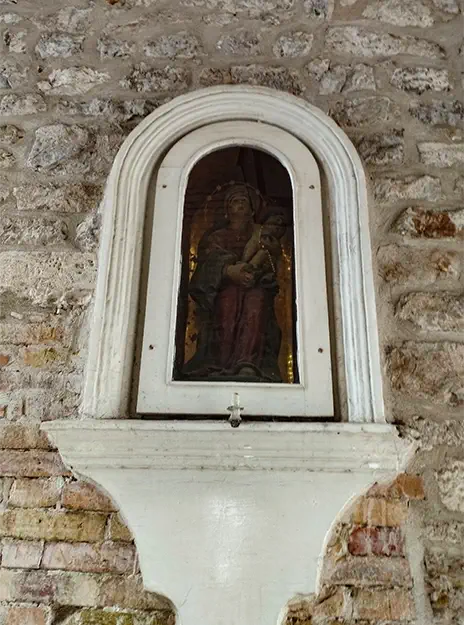
Several artefacts can be found within its walls, including a rare bas-relief of the Virgin Mary, made of blackened olive wood — the Black Madonna. It was made by the Sarajevo sculptor Afran Hozić.

Belavista
Another name is Duke Stefan Vukčić Square. «Belavista» was the name given to it by the Venetians.
This is a small square in the heart of the old town, which is surrounded by several coffee houses. In the centre is the church of St Michael the Archangel, built in the 19th century, and the Karača drinking fountain.
Church of the Holy Archangel Michael (Crkva Sv. Arhangela Mihaila)
A church in the heart of the old town of Herceg Novi. It first appeared on this site during the reign of Stefan Vukčić. However, when the town was conquered by the Ottoman Empire, the church was destroyed and a mosque was built in its place. The mosque, in turn, was eventually destroyed by the Venetians who took over the city.
The church of St Michael the Archangel in its present form was received by the city in the early 20th century during the reign of the Austria-Hungary. Its appearance stands out from the rest of the city's religious buildings in that it incorporates an eclectic mix of neo-Byzantine, Romanesque, Baroque and Gothic styles. The architect was Milan Karlovać.
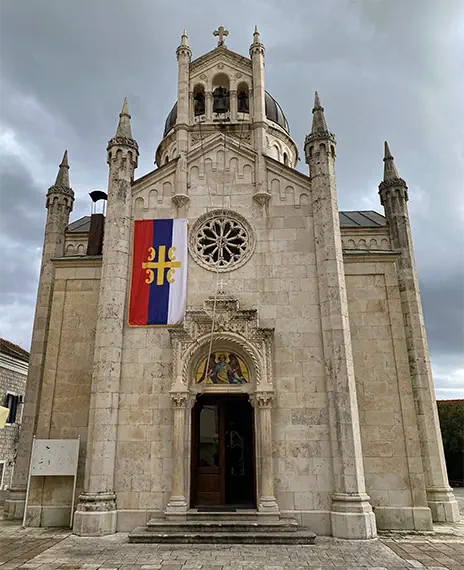
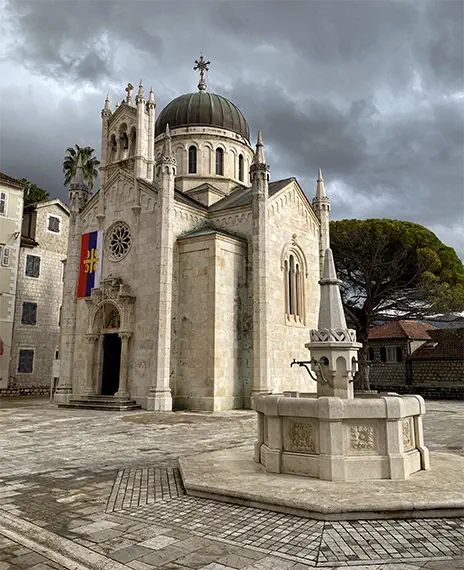
The interior decoration is by the Czech master Franier Ziegler.
Today, it is open to all comers.
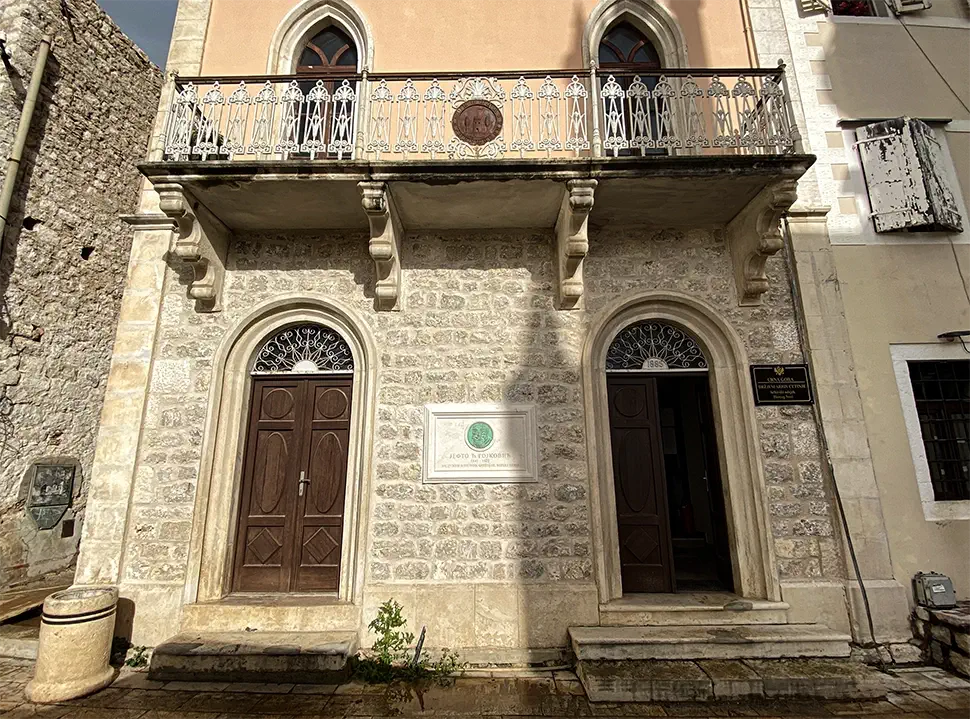
City Archives
Located in an 1885 building on Stefan Vukčić Square. The archive building was badly damaged in the 1979 earthquake, but has since been rebuilt. Today, in addition to the city archive, it is also a public library with around 30,000 books. And the oldest document dates back to 1685.
The Parish Church of St. Jerome
It is located south of Stefan Vukčić Square in Mićo Pavlović Square, closer to the fortress of Forte Mare. During Ottoman rule there was also a mosque, but the Venetians who replaced the Turks destroyed the mosque and built a church, naming it after the town's patron saint, St. Jerome. But the Venetian church was soon destroyed by a landslide. The only part of the church that survives is the bell tower.
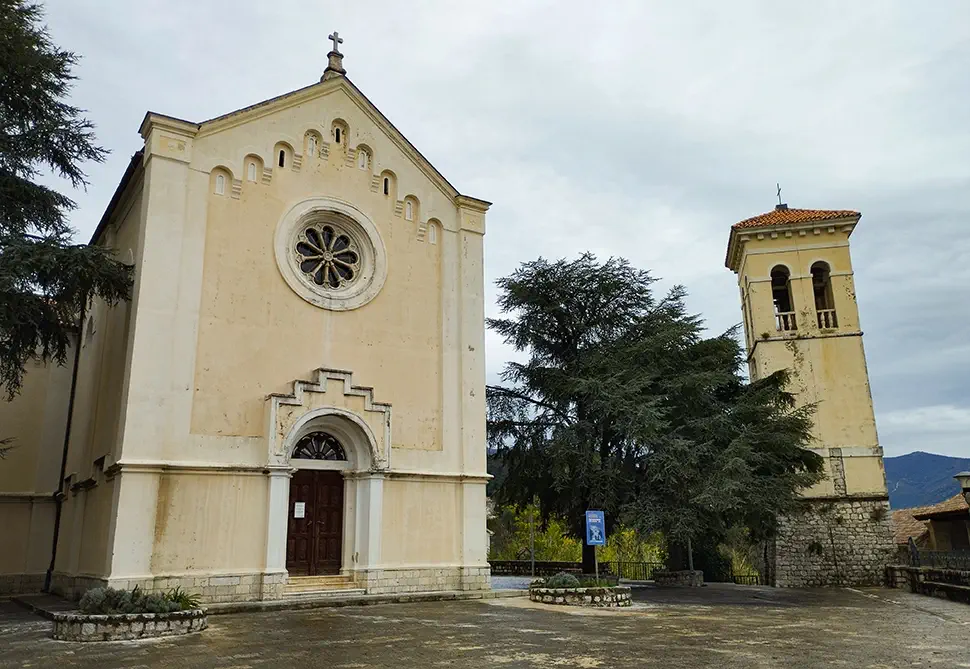
In 1856-1857 a new cathedral for Catholics was built on the site of the old building and called The Parish Church of St. Jerome. Some of the property of the old cathedral was salvaged and to this day adorns the interior of St. Jerome's Cathedral. For instance, there is a painting depicting the victory over the Ottoman army in 1687, led by Prince Jerome Korner. It was painted by Tripo Kokol (who is also known for the decoration of the Church of the Gospa od Skrpjela near Perast).
Today, due to a lack of parishioners, the cathedral only opens its gates on selected days.
Forte Mare
A fortress by the shore whose foundations were laid by King Tvrtko I Kotromanić. It is where the history of the city began. Later on, both the Ottoman Empire and the Republic of Venice contributed to its development. Its walls offer a beautiful view of the bay and the city. You can find out more about the fortress by following this link.

Entry fee in 2023 — €4 per person
Forte Mare opening hours
The castle is open to the public from 8 a.m. to 9 p.m. during the summer season (usually from 1 May to 30 October). At other times, visits are only possible in groups of 20+ people and by prior arrangement.
Bastion Citadella
Remains of the 18th-century fortifications built by the Republic of Venice. It is located at the foot of Forte Mare. In 1979, a major earthquake caused the Citadel to collapse into the sea. Today, its walls lie in the sea and serve as a «decoration» of the beach.
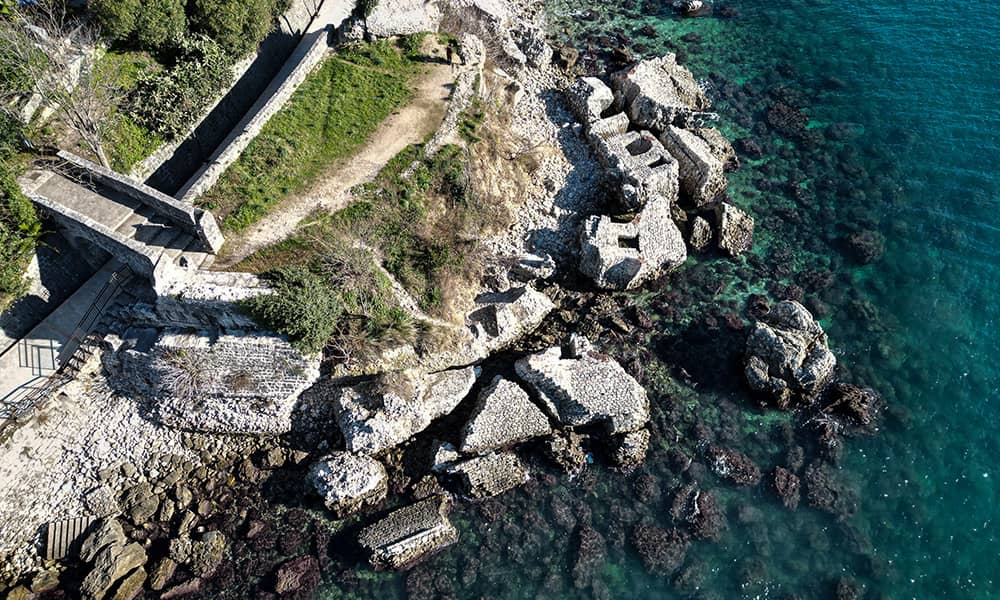
Read more about the Citadel here.
West Tower
The West Tower is the only surviving part of the city walls around Herceg Novi that once encircled the Old Town. It is located between Sahat Kula and Kanli Kula and is clearly visible from the square in front of the Clock Tower.
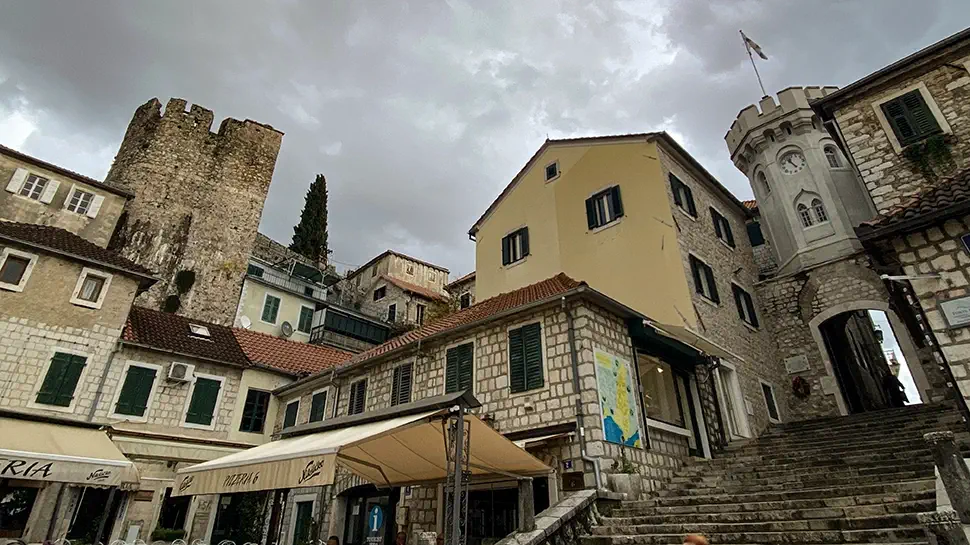
This tower is connected by a narrow passageway to Kanli Kula, but the entrance to it is closed. There is a reconstruction project that would make it possible to enter it through the «Donkey Door». It is so called because caravans with laden donkeys used to pass through it.
Kanli Kula
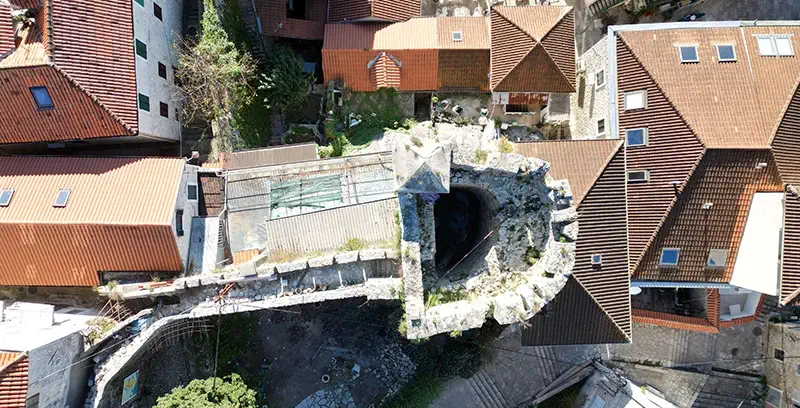
Kanli Kula, or Bloody Tower, is a prison fortress that the city inherited from the Ottoman Empire. Despite its grim past, it is now one of the most visited sites in the Old Town: after being renovated in the 20th century, it was used as a venue for film festivals, theatre performances and even weddings. It offers a beautiful view of the bay, which attracts thousands of visitors. Read more about the history of the fortress here.
Entry fee in 2023 — €4 per person
Kanli Kula opening hours
