
Ostrog is an Orthodox Christian monastery located inside the mountain called Ostroška Greda, located between Nikšić (13 km away) and Danilovgrad (15 km away). The Ostroge Monastery was built in the 17th century, and now it represents the main sanctuary in Montenegro. The monastery is also considered to be the third main Orthodox religious site in the world in terms of the number of pilgrims.


The Ostrog complex itself comprises two monasteries: the Upper and Lower. The first, the earlier one, is rightly considered the main monastery. It is situated inside the mountain. The lower part of the complex is about 5 km away from the main monastery and can be reached by road or by stone steps.
Founding history
There is no exact date when the first hermit monks came to the area. But records say that in the 15th century there was a fortress called Ostrog, but not a monastery. It is also known that two churches located here (Church of the Presentation of the Blessed Virgin Mary and Church of the Exaltation of the Honest Cross) existed even before the appearance of St. Vasiliy of Ostrog.
There are also frescoes inside the churches that date back to the 17th century. Their author is master Radul, a famous Serbian icon painter. However, St Vasiliy of Ostrog (born Stojan Petrović Jovanović) himself came here in 1665, after which he decided to found a monastery here. Therefore, there is no exact date of the origin of the holy place here.
The story of St Vasiliy of Ostrog
Stojan Petrovic Jovanovic, called even Vasiliy of Ostrog, was born on 28.12.1610 in village Mrkonichi (territory of then Herzegovina). His family was devout, so the boy showed interest in religion from his childhood.
Given the fact that Herzegovina was part of the Ottoman Empire in the 17th century, Stojan's parents decided to send the boy to the Zavala monastery (50 km from Trebinje, modern Bosnia and Herzegovina), where his uncle was serving.
After some time Stojan Jovanović goes to Trebinjski monastery Tvrdoš where he continues his studies in ecclesiastical matters. There he takes the monastic vows and chooses the name Vasiliy. After spending a period in Tvrdoš, Vasiliy goes to the monastery of Cetinje, where Metropolitan Mardarius was abbot.
However, as time went on, there was a conflict between Vasiliy and Mardarius: in the 17th century the Balkans were dominated by the Turks, who with varying zeal tried to eradicate Christianity from their empire. The Vatican, in turn, through its Jesuit preachers, began offering help in return for church unity under the Pope. It must be said that this was the solution to which Mardarius was inclined. Vasiliy, on the other hand, was against such an idea. He thought that if he defended the truth of Christ, the Christians in this land had nothing to fear and no one's help was needed. Anyway, Vasiliy leaves the monastery of Cetinje and returns to Tvrdosh: he serves God, preaches, comforts and helps people.
Seeing his popularity among the people, the Turkish authorities decide to kill Vasiliy, but he manages to escape.
Vasiliy goes to the Russian Empire, from where he comes back with gifts and money, which he spends to help people and rebuild churches and schools.
After completing these good works, the monk went to Mount Athos, Greece, where he spent a year, and returned to Peć, where Vasiliy was expected by Patriarch Paisii. After his deeds, in 1638 Vasiliy has ordained Archimandrite, and 13 years later, after the metropolitan of Eastern Herzegovina was killed by Turkish soldiers, he came to Onogost (now the town of Niksic in Montenegro), where he was appointed the new metropolitan.
From this point on the hunt begins for Vasiliy. He has to hide in many monasteries, until finally fate leads him to Ostrog, where in 1665 he starts building a monastery.
The metropolitan died in 1671 and at the place where he died, amidst stones and without a single scrap of earth, a vine grew and it still grows there today. Its fruit is believed to cure infertility.
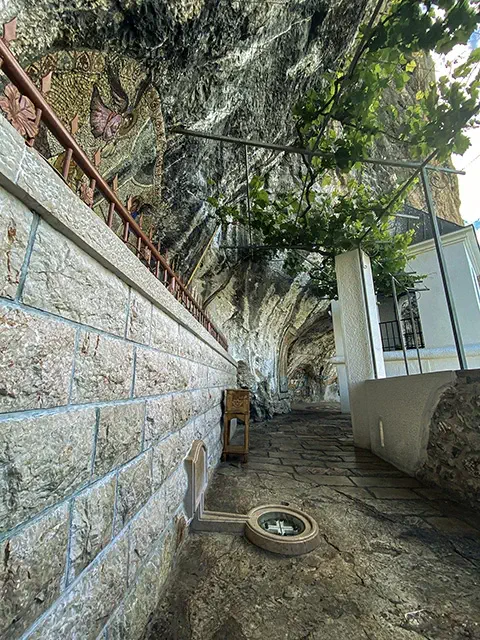
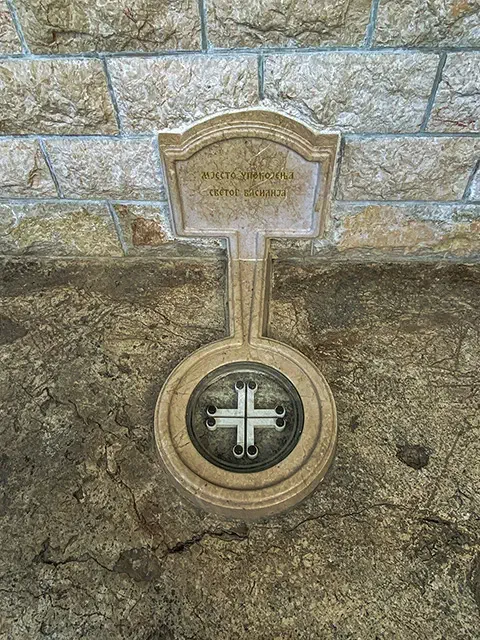
History of the monastery after the death of Vasiliy of Ostrog
There is a legend that after his death (29 April), St Vasiliy of Ostrog was buried in the ground like an ordinary person. But 7 years later, he began to appear in a dream to monk Raphael, asking him to remove his coffin. At first, Raphael paid no attention to the dream, but it was repeated several times. Raphael told his colleagues about it, but they did not pay any attention to it. One day, however, after another apparition, the monk got burns on his forehead and it was decided to visit Ostrog with other monks to dig up the body of the Saint. Before digging out the coffin, they fasted and prayed near the tomb of Vasiliy for 7 days, and then they took out the body of the deceased from the burial place. In the open coffin, they discovered the imperishable body of the elder, which had undergone absolutely no deformation of any kind. After this, Vasiliy was elevated to the rank of a saint and his body is still kept in the cell of the Church of the Presentation of the Blessed Virgin Mary.
In 1714, Ostrog monastery was attacked by the Bosnian vizier Numan-pasha Čuprilic with his army, but the monks knew about it beforehand and managed to remove the relics, burying them near the Zeta River. A year later the relics were unearthed and returned to the monastery. Interestingly, there were several floods during this time, but the relics remained unharmed.
The Monastery of Ostrog was attacked more than once, but all of its relics were saved.
It is worth noting that in the 18th century this place was a haven for all those who fought for their faith and the independence of Montenegro.
In 1852 the Turks led by Omar Pasha stormed Ostrog. The monastery was defended by only 30 men, and the defence was commanded by Prince Mirko Petrovic. The siege lasted for 9 days, and on the night of the 10th day the relics were taken out of the monastery. They were temporarily hidden in the Church of the Nativity of the Blessed Virgin Mary in Cetinje, and in 1853, they were brought back.
In 1877 the Turks made another attempt to destroy the relics by burning the monastery, but the Montenegrins knew about the attack beforehand, so the relics were taken to Cetinje again beforehand by order of King Nikola, and brought back in 1878.

In 1923, a great fire destroyed the cells of the Upper Monastery (except for the cave churches and the cell of St Vasiliy), but they were immediately restored. Archimandrite Leontius Mitrović was in charge of the restoration and the architect was Vladimir Sukurenko, an emigrant from the Russian Empire who came to the Kingdom of Yugoslavia.
Also in 1925, the mountain monastery was visited by King of Yugoslavia Aleksandar Karađorđević, who donated a large sum for the restoration of the shrine.
In 1926 the monastery was as we see it now.
In 1941, the Kingdom of Yugoslavia was fighting against the armies of the Axis countries. During this period, on the night of 14-15 April, King Petar II Karađorđević spent the night in Ostrog before leaving the Kingdom.
On that night Peter II Karađorđević handed over three great relics to the monastery:
- the right hand of St John the Baptist;
- an icon of Our Lady of Philerimos;
- a piece of the Holy Cross.
After the war they were confiscated by the new authorities and placed in a special depository located in Podgorica. They were recovered only in 1993. The right hand of St John the Baptist and a fragment of the Holy Cross were given to the monastery in Cetinje, while the icon was given to the National Museum of Montenegro, which is also located in the first capital of Montenegro.
Lower Ostrog Monastery
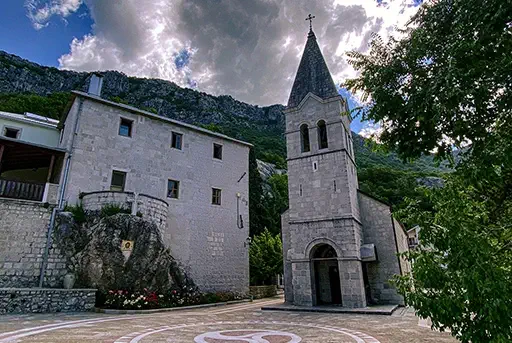
The most common starting point for tourists to visit Ostrog is the Lower Monastery (Donij Manastir). There used to be a small village called Kosjeradici on this site. When Metropolitan Vasiliy decided to found a mountain monastery, he bought the area and built a granary and a youth house on it. Over time, this place became known as the Lower Monastery.
The official foundation date of the Lower Monastery is considered to be 1820. Then Archimandrite Joseph Pavicevich, with the permission of St. Peter of Cetin, begins to build the monastery of the Holy Trinity here. Cells, a church (1824) and a house that serves as a shelter for pilgrims to this day were built.
Also next to the monastery was the church of St George. Excavations have revealed that it was built at the end of the 18th and beginning of the 19th centuries. During the Ottoman rule, the church was demolished several times, but was reconstructed each time, until 1895, after another demolition, it was abandoned. The ruins are now located near the old cemetery of the monastery.
The most modern building of the Ostrog monastery is the Church of the Holy Martyr Stanko, built in 2004. Stanko Alexić was a young shepherd from a village near Danilovgrad who refused to convert to Islam on September 15, 1712, and paid with his life for it. During his execution, he held a cross and the Ottomans, as an instruction to others, cut off Stanko's hands. The 15-year-old shepherd died of his injuries. The story gained publicity and for this he was elevated to the rank of New Martyrs.

There are also the graves of 27 Chetniks, including Colonel Bajo Stanišić and General Blažo Đukanović, who died defending Ostrog against the Communists in 1943.
Upper Ostrog Monastery
The relics of St Vasiliy of Ostrog are kept here and 12 monks reside in the monastery itself on a permanent basis.
The two-storey monastery inside the mountain attracts crowds of pilgrims every year, eager to visit the miraculous relics. There are two churches on its territory - the Church of the Presentation of the Blessed Virgin Mary, dating back to the 17th century, and the Church of the Exaltation of the Honest Cross, which was built in 1665.


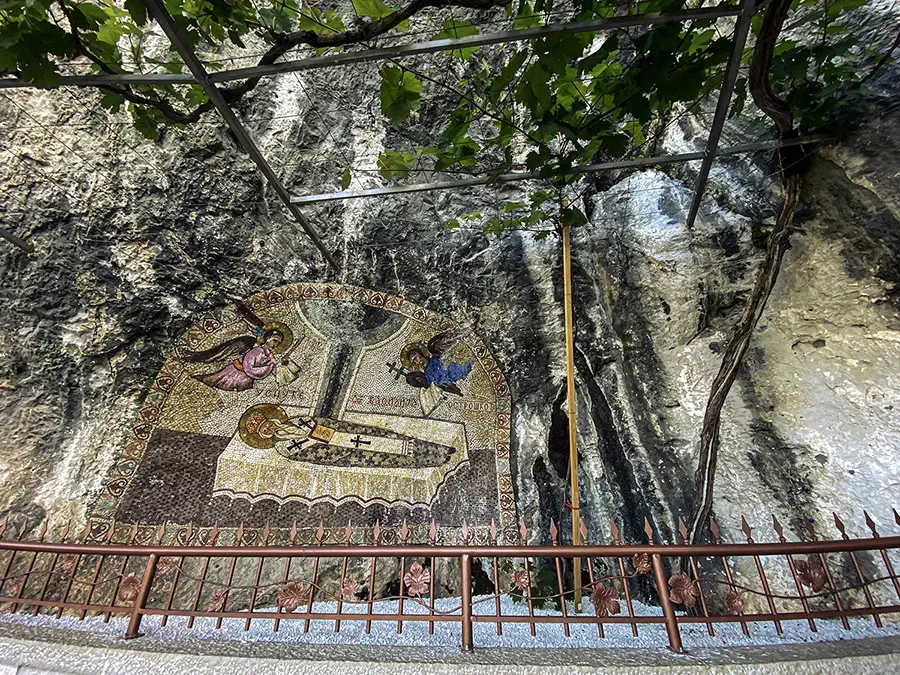

It is noteworthy that the first church was erected on the site of an ancient cave on the lower tier, its area not exceeding 10 square metres. Vasiliy of Ostrog spent about 15 years praying in this place, and it is now the place where the saint's relics are kept.
On the upper tier is the second church, where ancient frescoes from the 17th century, painted by Serbian masters Radula and Jovan, have been preserved.

When visiting this place, be sure to stop by the monastery's shop. There you can get a bottle of water from the healing spring and a small jar of oil. It is free to all, but only one per person, so you can bring it to people who couldn't make it to the monastery.
In addition to the churches, the Upper Monastery also has:
- 2 parkings (both are free, but the top one is handicapped and pregnant only; the lower one is only a 10-minute walk away)
- Healing Spring — this is where the water is dispensed, so if you have a bottle with you, you can draw your own water.
- A souvenir shop where you can buy the monastery's products: honey, wine, tinctures, ointments, icons, tea, etc.
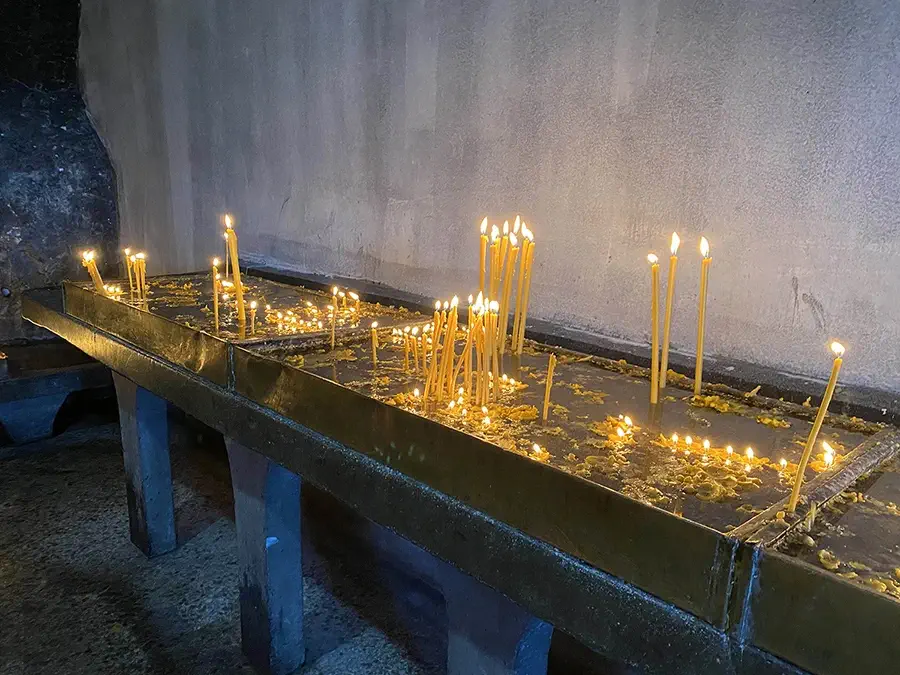
- A monastery shop (not to be confused with a souvenir shop) — here you can buy candles and, as mentioned above, get a bottle of healing water as well as a bottle of oil. You can also buy more of these items if you need more.
What to see: Ostrog shrines and relics
There are a number of relics and places of worship on the territory of Ostrog Monastery that may be of interest to the visitor. Here is a short list:
- The vine that sprouted through the stones at Vasiliy's of Ostrog resting place;
- Holy relics of Vasiliy of Ostrog;
- A prayer book dating back to 1732;
- Healing Spring (in front of the main gate);
- Chains kept in the Church of the Holy Cross. They serve as evidence of a man's healing from rabies;
- Wreckage of a grenade (which we wrote about above);
- Ruins of the historic church of St George;
- Relics of the hands of Stanko the Great Martyr.
How to get to Ostrog
It is worth noting that there is no direct transport to the Ostrog monastery. So from the options, you have to buy an individual or group tour, rent a car or get to Ostrog monastery by public transport + hitchhiking or on foot.
How to get to Ostrog Monastery by car
Many people recommend driving to Ostrog from Danilovgrad because the road is wider on that side. However, if you happen to drive from Niksic, don't worry. Although the road is narrow (two cars can only pass each other on the side of the road), there are not many cars on it and if you follow the traffic rules, you won't have any problems.
You can park in one of the three car parks when you arrive:
- Near the Lower Monastery — sightseeing buses also stop here;
- Near the Upper Monastery — not everyone is allowed, only disabled people, pregnant women and people with small children;
- Parking just before you reach the Upper Monastery - you won't miss it here, as a member of staff supervising the uphill passage to car park no. 2 will show you where to turn.
If you happen to be staying downstairs but don't want to walk up, look for a nearby monastery shuttle service - for 2.5 euros per person they'll take you upstairs.
How to get to Ostrog Monastery by public transport
As mentioned above, there is no direct public transport to the monastery. However, if you decide to travel on your own, the following information will be helpful.
Bus
You can take any intercity bus between Niksic and Podgorica. Your destination is «Bogetići». The ticket from Podgorica costs about 3-4 euros, from Budva about 6 euros..
Then you have three options
- Walk (about 10 km);
- Catch a hitch;
- Take a taxi the rest of the way (approximately €10).
Train
From Podgorica you can also go to Ostrog by train. You need one of two stations - Ostrog or Dubovići. The first station by its name hints that it is the right one, but in fact it is easier to go from the second one, so it is up to you to decide.
You can check the train timetable on this website. You can buy tickets either at the station or from a ticket inspector inside.
Getting to Ostrog Monastery from the Ostrog railway station
The trail from Ostrog Station to the Lower Monastery is about 2 kilometres long, but it is mountainous. This means that you will encounter rocks, narrow passages and other such delights along the way. So we recommend that you wear tracking shoes.

Despite the difficulty of the climb, the trail is well marked, so it's unlikely to get lost, but it's best to download an offline map beforehand.
The length of the walk: +- 1 hour.
Getting to Ostrog Monastery from the Dubovići railway station
Unlike the previous version, the path from the Dubovići railway station is on an asphalt road, which naturally makes it easier to walk. It is about 4 kilometers long. In addition to the good and comfortable pavement, you will also find restaurants and wineries along the way, where you can catch your breath and replenish your energy.
Also, keep in mind that you'll be following a panoramic road, which means you'll have several locations for beautiful photos. And if you do get bored of walking, you'll have the option to hitchhike.
The length of the walk: from 1 hour.
Rules for visiting Ostrog Monastery
The dress code of the monastery is not strict. Women need to wear clothes that cover their knees and shoulders to visit the monastery. Long skirts and dresses are not compulsory for women, you can also visit the temple in trousers. Many also cover their heads, but this is also optional.
Men should wear trousers or jeans, but if you happen to be wearing shorts, don't worry (unless they are swimming trunks), you will be allowed to enter the monastery anyway.
