
Ratac Monastery or Ratac Abbey (Italian: Santa Maria de Rotezo, Serbian/Montenegrin: Манастир Богородице Ратачке) is a ruined Benedictine monastery complex between Bar and Sutomore. In its heyday, the Abbey of Ratac was under the jurisdiction of the Roman Catholic Archdiocese of Bar.
This complex was notable at least for the fact that the Orthodox and Benedictines peacefully co-existed on its territory. The relationship between the Eastern Orthodox and Benedictine monks in Ratac was so close that they participated in church services and took part in common processions and processions.
Today, the complex has been destroyed, with the remains of the fortress monastery walls as well as the walls of the churches.

Infrastructure of the monastery
Today, the infrastructure of the complex includes a few ruins and the remains of old walls. However, in its heyday, it was a powerful economic unit of the region. Its territory and estates stretched from Old Bar to modern Petrovac.
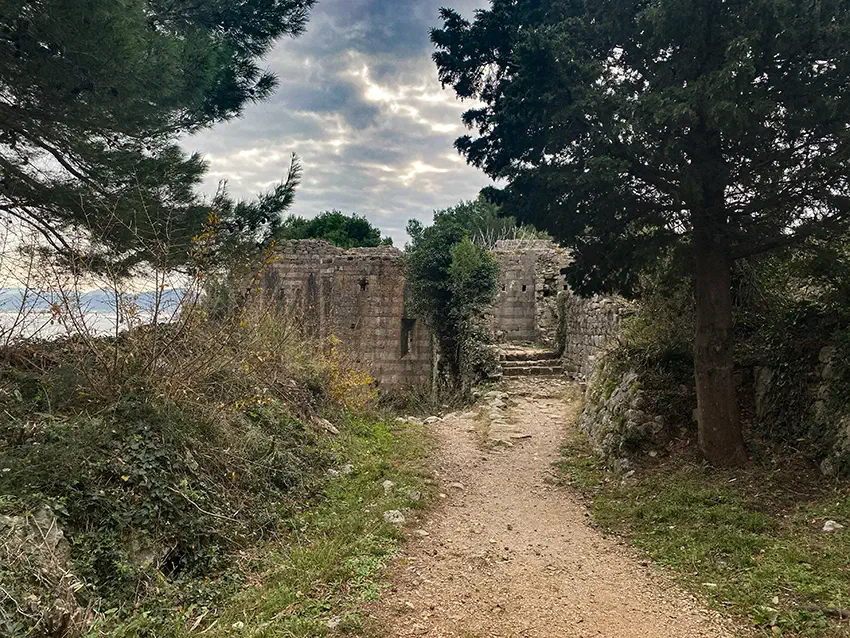


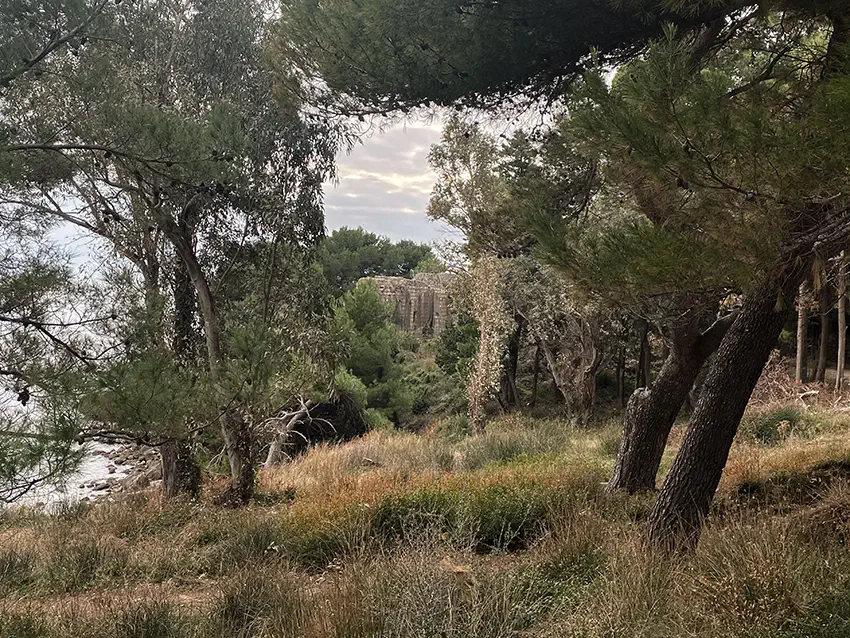
The monastery complex itself included temples, dwellings and other buildings, which were surrounded by fortifications: stone walls and towers. Archaeological excavations have uncovered the remains of three temples, as well as a water pipe from a local spring.
Near the abbey there was a wharf for small ships, and the shores were sources of drinking water. The land belonging to the abbey produced both vegetable and animal products, which were then sold to visitors. Among the crops grown were olive trees and grapes.
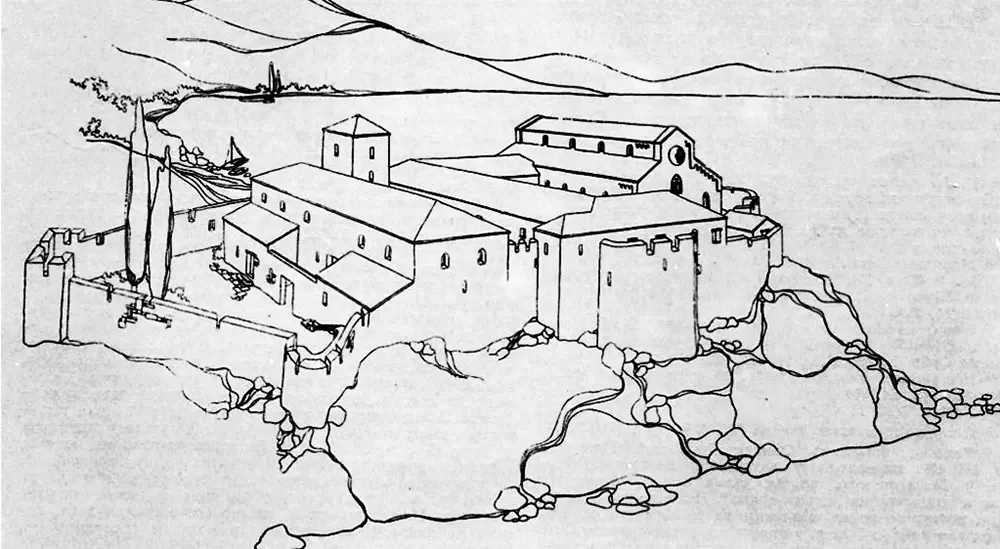
There was also an oil mill, a mine for building stone (of which Ragusa (modern Dubrovnik) was one of the buyers).
The abbey was not shy of financial services. Loans and credits were granted to neighbouring princes, one of whom was Balsha III.

There was a hospital for the poor on the site at least in the 15th century. They also tried to cure leprosy here.
Ratac Icon of the Virgin Mary
The Ratac icon of the Virgin Mary was very famous among visitors to the monastery. There was a custom that pilgrims and sailors, especially from the cities of Kotor and Dubrovnik, returning from long journeys, were obliged to bring gifts to the Virgin Mary. Those parishioners who could not make the journey on their own had the opportunity to pay for a service to have other travellers present gifts to the Blessed Virgin on their behalf. In 1443, the miracle-working icon was transferred to the Church of St George in the city of Bar. However, after the capture of the city by the Turks in 1571, the icon disappeared.
History of the monastery
The earliest mention of the monastery dates back to the 13th century, namely 1247. At that time, the local religious building was consecrated in honour of Saint Michael the Archangel.
It is not excluded that certain religious buildings existed here earlier, but there is no documented information about them. However, there is an opinion that the first temple on the cape was erected in the IX century. And the first residential buildings date back to the V-VI century, i.e. to the time when the Slavs first settled near the Adriatic Sea.
In 1310, Serbian King Milutin and his mother Helena of Anjou built a church and monastery here. At the beginning of the 14th century, it was consecrated in honour of the Holy Virgin Mary. However, as it developed, the monastery increasingly attracted the interest of the surrounding rulers as well.
It is documented that already in the fourteenth century it faced its first serious tests of fate. In 1392, a war of independence broke out between Radić Crnojević (founder of the Crnojević dynasty) and the then owner of Zeta, Đurađ II Stracimirović of the Balšić dynasty, which covered the territory from Kotor to Bar. Radić was killed in May 1396, but the monastery's holdings were damaged. In addition, already in July 1396, there was a powerful earthquake, which brought even more destruction. The monastery was rebuilt and, remarkably, the materials were helped by Dubrovnik, with which Ratac had close ties.
However, the victory of Đurađ II did not save Ratac from a change of ownership. In the same year, 1396, Sandal Hranjic Kosač, a relative of the founder of Herceg Novi, seized Budva and chose the rebuilt and fortified monastery as his dwelling place.
After 2 years, in 1398, the Balšićs managed to regain control over Ratac, but 7 years later, in 1405, these lands, together with Bar, Budva and Ulcinj, became fully under the control of the Venetian Republic. For the next 4 years, the rulers of Zeta tried to regain the monastery through diplomacy, but these efforts came to nothing. Therefore, in 1409, the First Skadar War between Balšići and the Venetians for the return of the territory began. It resulted in a peace treaty in November 1412, according to which the lands obtained by the Venetians in 1405 were returned under the rule of Balša III Balšić.

The Ratac monastery belonged to Balša III until his death in 1421, after which it was returned for three years to the Venetians, who in 1425 ceded it to Balša's successor, Đurađ Branković.
In the next 35 years, the ownership of the monastery alternately passed to Stefan Vukić Kosać (1442), the Venetians (1443), the Paštrovićs (1448) and Stefan Crnojević (1457).
Under Stefan Crnojević there was a division of lands into Catholic and Orthodox.
By the end of the 15th century, the Ratac Monastery was under the pressure of Ottoman raids. In the autumn of 1499, a Turkish detachment of 100 men from Bar, supported by 10 ships from Ulcinj, plundered the surrounding area. At this time, 1,500 locals are hiding behind the fortress walls of the abbey. Negotiations between the Venetians and the Ottomans fail and for the next 30 years the raids and plundering continue unabated.
In 1531, the Ottomans issue a ban on cultivation and harvesting, and the monks are dispersed in the process. In 1544 the Senate of the Republic of Venice allocates funds for the restoration of the abbey. But the attacks of the Turks do not stop, and so already in 1558 the fortress walls of Ratac again need to be repaired and strengthened.
According to documents, the final decline of the monastery and the cessation of rites occurred in 1571 with the final cession of territory to the Ottoman Empire. Leaving, the Venetians tried to negotiate with the Turks to allow the freedom of Christian services. And there is some information that certain rites were held until 1579.
To date, the exact date of the destruction of the monastery by the Ottomans has not been preserved. However, an eyewitness testifies that in 1637 only the walls were left of the monastery, and all the buildings lay in ruins.
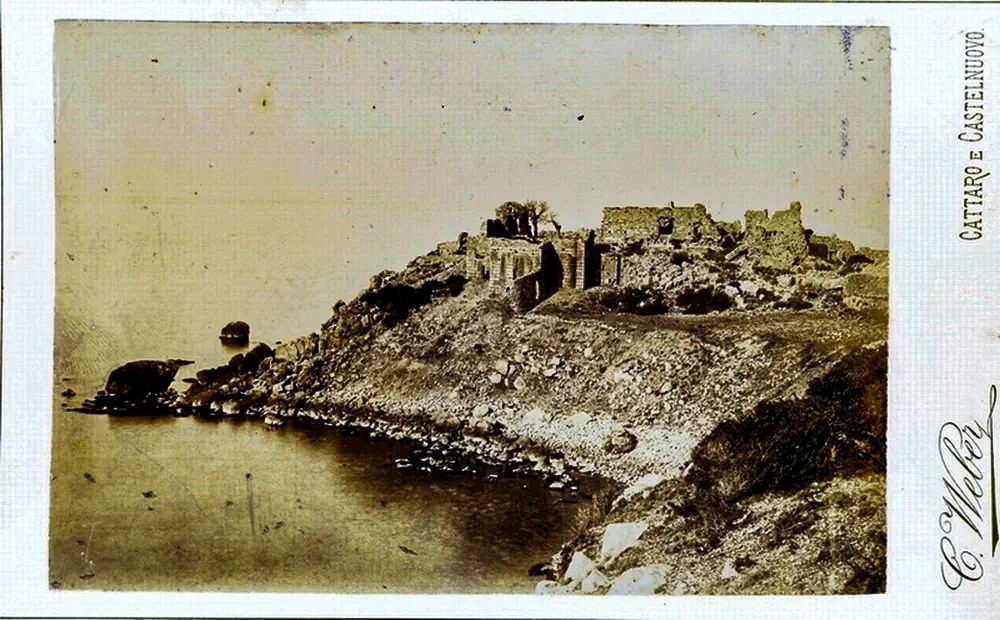
Later the territory of the former abbey was used by the Montenegrins in 1877 and by the Italians during World War II. The latter further destroyed the remains, turning them into a bunker and ammunition depot. The destruction of the historic site was completed by the communists: the Yugoslav military equipped the area for themselves in the 1950s. At that time, the miraculously alive observation tower disappeared, and even the foundations of many buildings were lost.
Ratac Monastery today
Today the abbey is a barely recognisable, plant-covered ruin. The vaults have been preserved only around the main altar of the former church of St Mary. This is where the Ratac icon of the Virgin Mary used to be located, which has become an object of worship for many pilgrims.

Catholics visit Ratac twice a year: on Holy Thursday (the 60th day after Easter) and on 15 August, the Feast of the Assumption of the Virgin Mary. Orthodox believers go on pilgrimage on 3 June, Constantine's Day.
Nudist beach at Cape Ratac
As mentioned above, today Ratac Monastery is in ruins and the faithful gather here no more than 3 times a year. However, during the summer season, the deserted beaches with crystal clear water at the foot of the former monastery attract the attention of nudists.
The nudist beach at Ratac Monastery is considered a male beach, which is worth considering when planning a visit.
How to get to Ratac Monastery
You can get to the ruins of Ratac Monastery either by car or by public transport, which runs between Budva and Bar. Your stop is here, just ask the driver to leave near Ratac. There is also a parking space here.
