
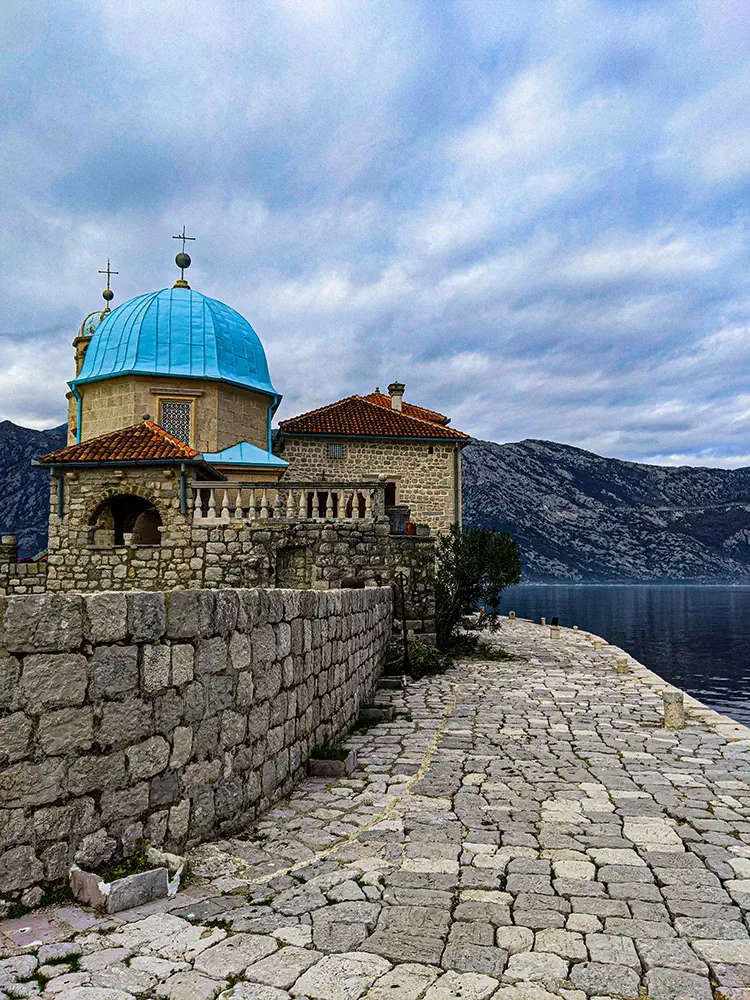
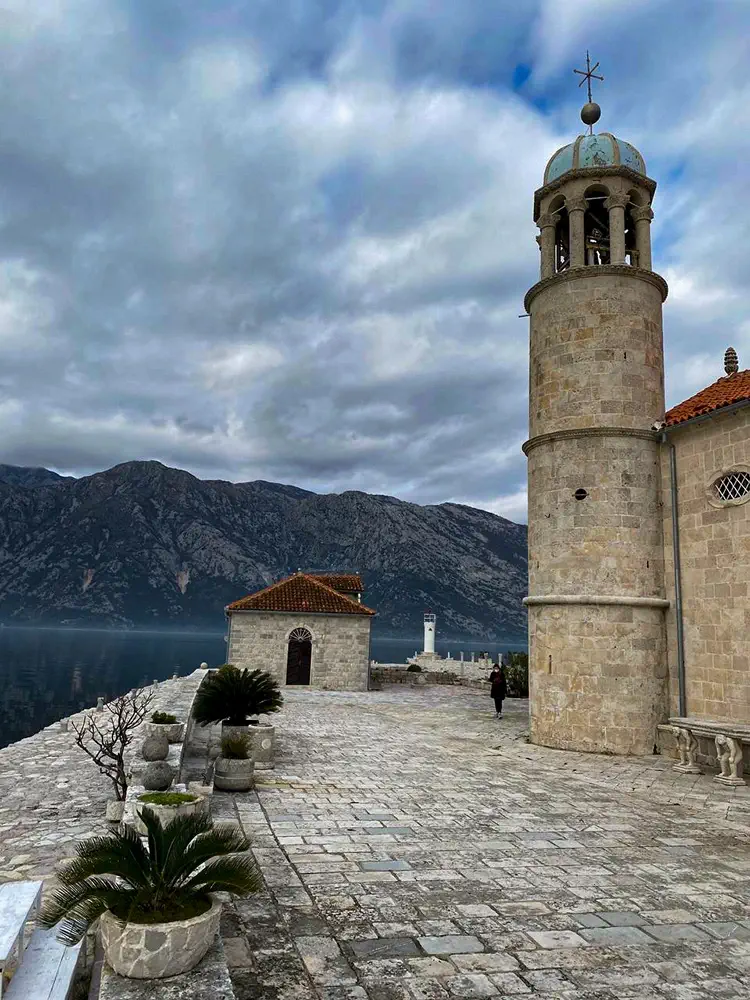
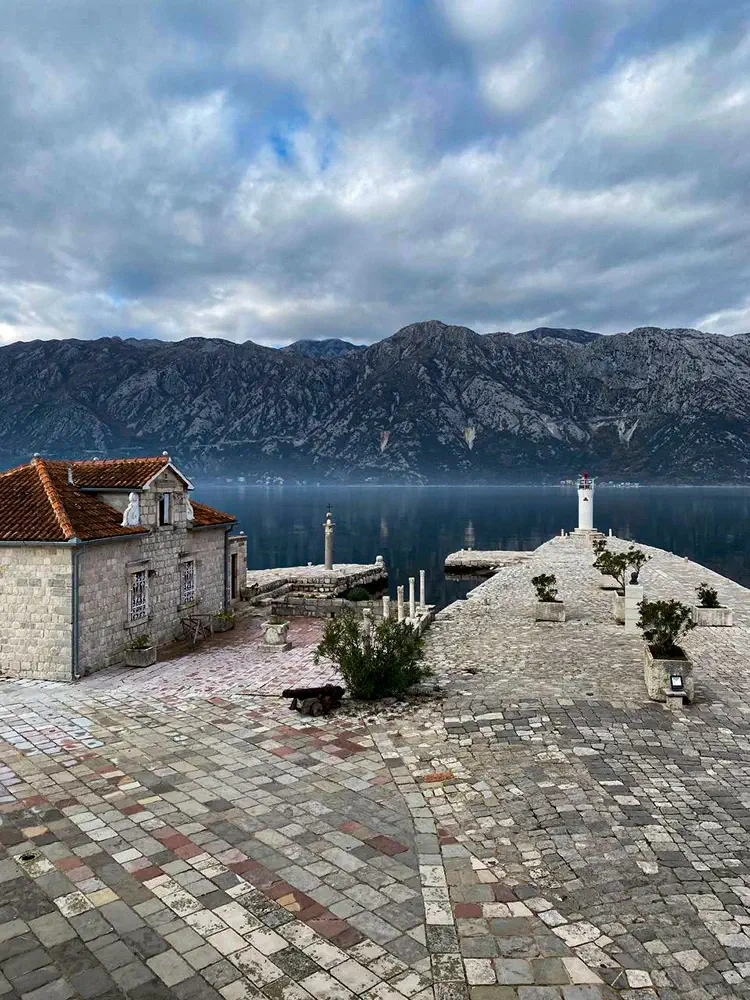
Gospa-od-Skrpjela, Our Lady of the Rocks or «Madonna on the Reef» is one of the most famous sights in Montenegro, a 15th-century church built in the middle of a bay on a man-made island opposite Perast. It is believed to be the only artificial island in the Adriatic.
Every year it attracts many tourists from all over the world. In different sources the names of this location may differ, and you can meet the following spellings:
- Gospa-od-Skrpjela;
- Gospa od Skrpela;
- Our Lady on the Reef;
- Our Lady of the Rocks;
- Holy Virgin Island;
- Virgin Mary on the Reef;
- Chiesa della Madonna dello Scarpello;
- Madonna on the Reef
However, the locals still call it Gospa od Skrpjela (from the Latin «scropulus» — «reef»). Next to it, there is another island, already natural, which is called St. George's Island. You can read about it separately.


History
There are at least two theories of the origin of the island: one is more like a legend, the other is a politically verified solution.
The Legend of the Founding of Gospa-od-Skrpjela
Since time immemorial, there was a reef near St. George's Island, where it was convenient to tie up boats so that they would not drift out to sea while fishing. According to legend, there were two brothers with the surname Mortesic in Perast who went out daily to the bay to fish and tied up their boat at the reef. One of the brothers had problems with his leg, which no one could cure.
On July 22, 1452, during another mooring on the reef, they saw a shiny object on the bottom, which turned out to be an icon of the Virgin Mary. The brothers took it home with them.
The story goes that after praying to the found icon, the brother's leg was healed. Word of this quickly spread throughout the Bay of Kotor and the decision was made to build a church on the site where the icon had been found.
In order to turn the reef into an island, the ships that had already served their time were sunk near it, having previously loaded them with stones. Also, a decree was issued, according to which all ships that call at Perast are obliged to drop one stone near the reef.
So over time, the reef became a plateau on which the church was built.
According to an alternate version, the Mortesic brothers' ship wrecked in a violent storm on a reef near Perast, near St. George's Island. After waking up on the rocks of the reef and realizing that by some miracle they were alive, the brothers noticed a glittering object in the depths, which turned out to be an icon. Without an ounce of doubt, they took the icon with them.
However, the very next day it was gone and was found again in the «old» place by the reef. This was repeated an indefinite number of times until the brothers decided to build a temple in the place where they found the icon each time. But the reef was too small to build on, so the Mortesici began to tell their magical story of salvation to the townspeople. Word quickly spread throughout the area, many volunteers became involved in their project and together the construction succeeded.
The Political Theory of the Founding of Our Lady of the Rocks Island
The island of St. George, also known as the Island of the Dead, is a natural island, which is located in the waters of Perast, but never belonged to it, but was under the authorities of Kotor. Naturally, this state of affairs did not suit the local elite and therefore there have been many conflicts on this ground.
Given that in those days Perast was quite a wealthy city with influential patrons and a wealthy population, the likelihood of armed conflict was more than real.
In order to reduce the possibility of the conflict, the Perast authorities took a creative route: they built their own island with a temple, just 115 meters from the Kotor island.
Church «Our Lady of the Rocks»
As mentioned above, beginning in 1452, the citizens of Perast began to build the foundations for the temple by sinking old ships loaded with stones. Pirate ships and other vessels of the enemy were also sunk here.
This went on for almost 180 years. Approximately in 1630, the platform received the modern outline of the area of 3030 m², and the Church of the Mother of God was erected on it. The main shrine of the temple was and still is a 15th-century icon, executed on a cedar board, the authorship of Lovar Dobricevic, which appears in legends.
On April 6, 1667, due to a massive earthquake, the structure was destroyed. However, the seventeenth century was the period of maximum prosperity of Perast, so after the destruction the citizens began to rebuild the temple with double zeal, lavishly decorating it.
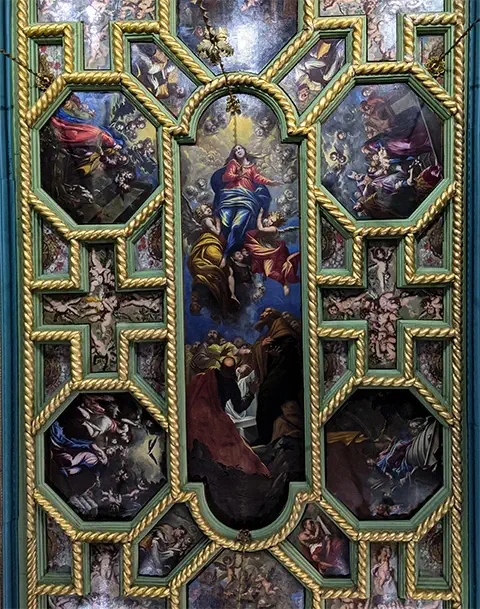
Thus, Archbishop Andrija Zmajevic invited master Tripo Kokol for painting the church, which was conducted from 1685 to 1695. A total of 68 oil paintings on canvas were painted, which are still located on the walls and ceiling of the church (but were restored) and framed in gold frames in the form of a rope. The most famous is the ceiling painting «Assumption of the Virgin Mary».
All indications are that the reconstruction was completed only in 1722. The church was rebuilt in the Byzantine style, expanded, and decorated with a dome and a bell tower 11 meters high. It is in this form that tourists see it today.
Earlier, in the attached bell tower, there was a so-called «reconciliation hall». In fact, it was the place where the courts were held. It was believed that near the holy place it was impossible to make a wrong decision. Nevertheless, many blood feuds and conflicts were stopped there.
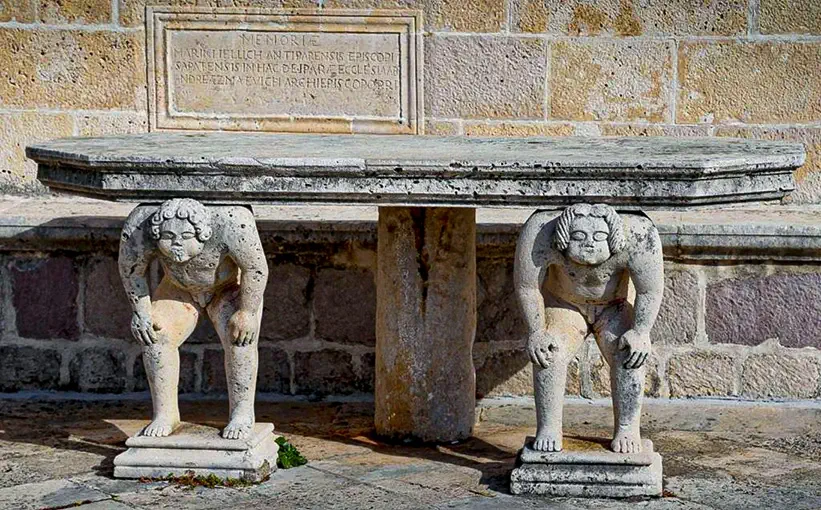
Today all that remains of it is a stone table with legs in the form of figures of naked men, which is located in the open air near the church wall. It is believed that if you sit at this table with your «enemy» and shake hands, the conflict will be over.
In addition to the works of Tripo Kokol, there are many artifacts inside the Church of Our Lady. Above the entrance is a Venetian organ, more than 300 years old, and the walls on the sides are decorated with many silver and gold plates — gifts to the temple from sailors and captains before going on voyages.
In 1796, an altar of Carrara marble was installed in the church, on which the Genoese sculptor Antonio Capelano worked. and this altar to this day is an icon of Lovrentije Dobricevic «Our Lady of the Reef».
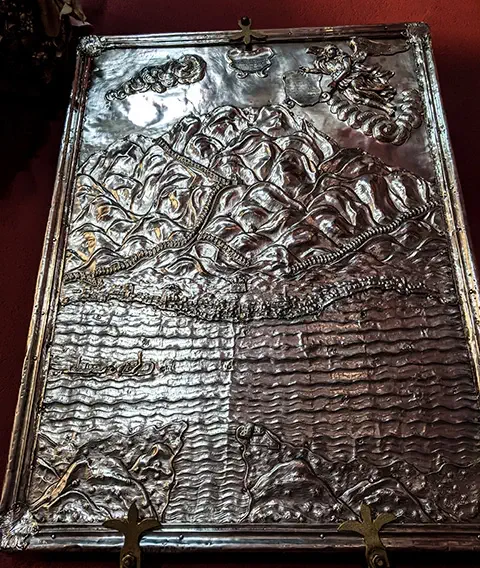
To the right of the altar can be found an 18th-century silver relief painting by Italian jeweler Francesco Costadoni. It depicts the battle that took place on 15 May 1654 between the inhabitants of Perast and the army of the Ottoman Empire. Despite the numerical superiority of the Turks, the Venetian (at that time) city was victorious. On the upper right, you can see the Virgin Mary saving the city from the attackers.
In 1815, the Bay of Kotor came under the rule of the Austro-Hungarian Empire. After that, the construction of roads and fortifications on the coast began. However, in spite of all the efforts, 100 years later the Austro-Hungarians lost the First World War and were forced to withdraw. During the retreat, they "seized" 28 bells in the churches of Perast and its surroundings. Twenty-seven of them were melted down for cannonballs and the bell from Our Lady of the Reef went home to an officer in Graz as a souvenir.
In 2011 it was brought back by the grandson of an Austrian officer.
Museum on the Island of Our Lady
In addition to the worship hall, there is also a museum in the temple building where both archaeological finds and gifts from visitors or residents of Perast are kept. There are two ways to enter here: the passageway to the left of the altar or from the street. As a rule, tourists enter from the side of the altar.
Inside the museum there are many artifacts from different eras: ancient amphorae and oil jugs, porcelain pieces, everyday objects. There is also a small collection of weapons, mostly raised from the bottom.
Our Lady Icon in the Museum of the Church of Our Lady of the Rocks
On the second floor, in a room with a stained-glass window, there is a collection of gifts. Its «pearl» is a tapestry copy of the icon of Lovrentij Dobricević, embroidered with threads and hair.
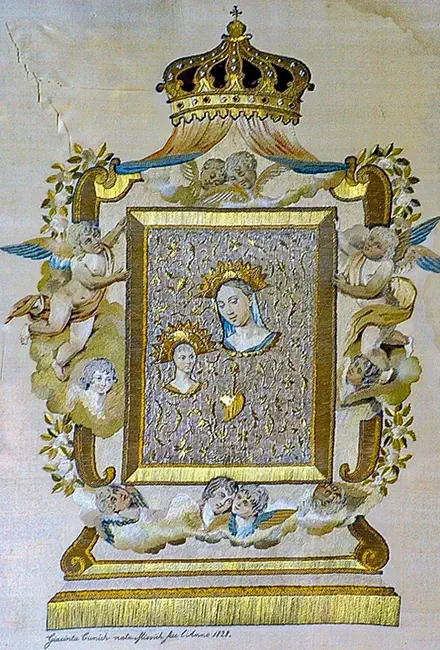
This icon was embroidered and donated to the church by Jacinta Kunic, a resident of Perast, in 1828. The peculiarity of the icon is that in addition to gold and silver threads, she used her own hair to create it, which is clearly visible in the hair of the angels: at first, they are dark, but over time they lighten and become completely white.
Jacinta embroidered the icon for 25 years, using seven different threads and materials. Such a length of time is due to the fact that the icon is made using the most complicated «punto pitura» technique: there are sections where about 650 stitches are made per 1 cm2.
According to legend, the icon was embroidered by Jacinta while she was waiting for her husband from his voyage. By the end of the work she was blind, but she never waited.
In reality, however, things may not have been so dramatic. At least there is no mention of blindness in Perast's archives. In addition, the threads used to create the tapestry are rare enough to get them just at the place of residence. This means that there is a possibility that it was her husband who brought such threads to her.
Fascinade
Fascinade (Italian. «fascii» — a bundle, an amalgamation) is a holiday and tradition that is more than 500 years old. Its essence is that every year on July 22, the inhabitants of the Bay of Kotor come to the island of St. Theotokos in boats and throw stones into the water to the base, thus continuing the tradition of their ancestors and strengthening it from being washed away.
What is interesting: despite wars and other cataclysms, since 1452 the tradition has remained uninterrupted, and in 2013 it received the status of intangible national cultural heritage.
How to get to Our Lady of the Rocks Island
As this is an island, although not far from the mainland, you will still have to get here by boat, boat or yacht. Before you come to this location, make sure that the museum and church are open in advance, otherwise you will have to walk around the island without going inside these sights.
If you do not have a rented boat or yacht, you can get to Gospa-od-Skrpjela in the following ways:
- Go as part of a tour from almost any city in Montenegro. In this case, the price will depend on the distance from the island, the tour program, and, directly, the tour company.
- Go on your own to Perast and from there take a boat to the island. In this case, the crossing itself will cost 3-10 euros (the price for the crossing, the entrance to the museum is paid separately) per person, depending on the number of people on board, the size of the boat, and the season.
Below we will look at how to get to Perast if you are going to drive on your own (without a tour company), where to park and where to drop off.
Personal or rented car
It is worth bearing in mind that in the summer season the whole Perast is a solid paid parking lot, and what is free is either occupied or a little against the rules.
However, you can still try your luck and try to find a place, for example, around this point.

If you arrive in late fall, winter or early spring, it is likely that you can safely park somewhere along the beach, often even for free.
Intercity bus
As you know, in Montenegro intercity buses are the most popular mode of transport, not counting private cars. But when you use the portal to search for buses and schedules, and enter in the destination field "Perast", most likely you will get an empty list.
The whole point is that, as a rule, the site database does not take into account small settlements along the way that do not have a bus station. However, any bus that goes along the bay, passes Perast and can drop off or pick up passengers. Accordingly, you need to enter the names of large (by Montenegrin standards, of course) cities in the search, one of which would be Kotor.
For example, if you're coming from Herceg Novi, then you need to look for the schedule for the route «Herceg Novi — Kotor» and if you're coming from Budva or Bar, then «Budva/Bar — Kotor» respectively.
Public transport
If you are staying in Kotor, you can take public transport to Perast — small buses marked «Blue Line». Given that they have the same route, it is difficult to get on the wrong bus, but just in case, you can always ask the driver if you can get to your destination.
