
The Moraca Monastery (Serbian: Manastir Morača) is a 13th century Orthodox monastery located in a picturesque valley next to the river of the same name. For many years it played an important role in the life of the population of the country as a cultural, spiritual and educational centre, as well as a centre of resistance against of the Ottoman Empire.


The Morača Monastery is representative of Raska architecture school with Romanesque and Byzantine style elements. Its main feature is its external simplicity and the rich interior decoration: icons and frescoes by the most famous Serbian and Kotor masters. The monastery is surrounded on all sides by stone walls, which have two gates on opposite sides.
Today, the monastery complex is open to all visitors. It consists of two churches, the Church of Dormition of the Mother of God and the Church of St Nikola, as well as several monastic cells, outbuildings, and a watermill. There is a school and an outpatient clinic nearby. Seven monks live here permanently.

History of Morača Monastery
The monastery was founded back in 1252, when Stefan Nemanjić, son of Vukan II Nemanjić (the Serbian king), laid the first building here.
After 250 years begins «a black period» in the life of the monastery: by 1505 the Ottoman Empire invaded almost all of the Balkans, seeking to reduce the influence of Orthodoxy in these lands. As a result many churches were ruined, burnt and destroyed. Morača was not spared this fate: the monastery was burnt down and its roof, made of lead, was used to make bullets for the Ottomans. As a result of these events, many original frescoes were damaged or destroyed altogether.


It was not until several decades later (according to some sources the work began in 1565, according to others in 1570) that the monastery began to be restored. The priest Tomo and Vukic Vučetić, the local village headman, were in charge of the work. By 1574 the church of the Dormition of the Mother of God had been restored and in 1577-1578 a new layer of frescoes was created. It is worth mentioning that the funds for these works were granted by the patriarch of the Serbian Orthodox Church Makarius Sokolovic.
By the end of the 16th century, Morača had become the focal point for the coordination of orthodox rebels within the Ottoman Empire. It was the starting point for shelter and secret meetings of the partisan haiduks, where uprisings are planned not only in the immediate area but throughout Montenegro.
The monastery also plays an important social role: it was the place where court sessions were held, and in 1648 Gavrilo Rajic became Serbian patriarch in the Morača monastery.

The monastery existed in this way until 1878, when the Ottoman Empire was defeated and left the territory of Montenegro. However, just before becoming part of the territory of the Principality of Montenegro, the monastery was subjected to another test. In June 1877, during the Balkan Wars of 1876-1878, the Ottomans made their last attack on the monastery.
It is noteworthy that the monastery had to be defended by armed local clergymen and the defence was commanded by an archimandrite named Pan Mitrophan, who was later elevated to the rank of metropolitan. His successful defence was later rewarded with a medal from the government.
A commemorative plaque with the names of the defenders of the monastery was erected in 2007.
The monastery was not given its present appearance until 1935, following reconstruction.
Church of Dormition of the Mother of God
The Serbian state of Raška has left its distinctive mark on many religious buildings in Montenegro. The Church of the Dormition of the Mother of God in Morača is no exception. It is a large single-nave building with a cylindrical vault and a semi-circular gallery, as well as a chancel (place for the singers).
Before 1505 the building had a lead roof and dome, but as mentioned above they were used by the Ottomans to make bullets. Later, after the reconstruction, the roof was made of wood, and the current metallic version was only acquired after the expulsion of the Turks.
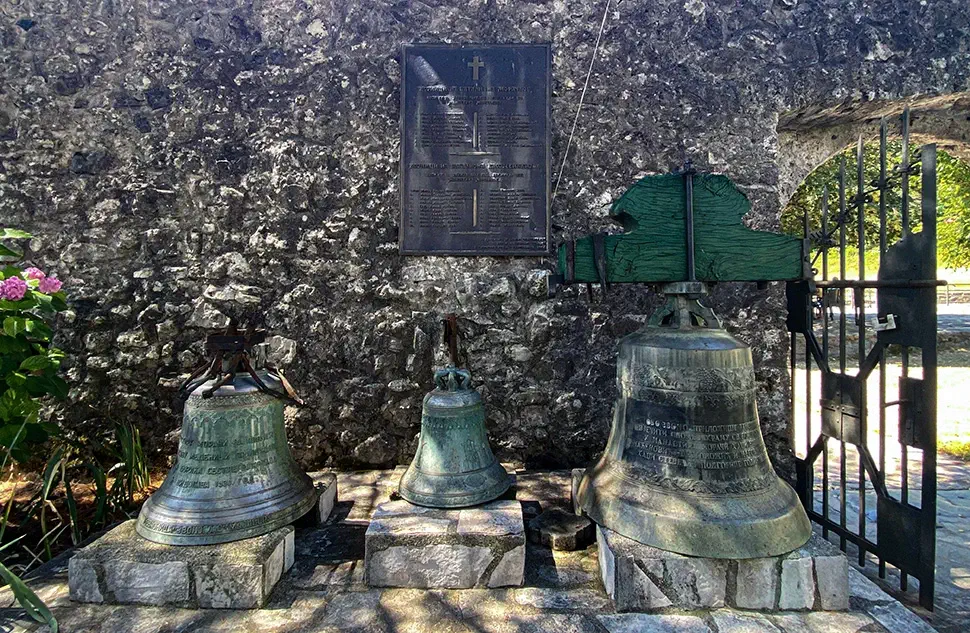
The church is built of lime tuff, a soft porous stone from nearby quarries, with the outer walls covered in plaster, something not found, for example, in churches on the coast. Another interesting feature of the church is that it does not have a bell tower, but there are bells next to it.
Inside the temple, a stone sarcophagus can be found. The founder of the monastery, Serbian Prince Stefan Nemanjić, rests in it. Mention of his name and the year of construction can still be found above the entrance to the church.
Another notable detail is the door, which is decorated with ivory. Along with the table, cane and armchair, they are examples of the most intricate and beautiful wood inlay.
Partially preserved frescoes from the hagiography of St Elias can be found on the walls of the church. According to some accounts they were created in the 16th century after reconstruction, others say they are the remains of a 13th-century painting.
It is also known that at the beginning of the 18th century, the frescoes in the Church of the Dormition of the Mother of God were added by masters of the Kotor school: the painting was done by Master Dimitri and his son, who finished an icon depicting the life of John the Baptist.
In addition to the frescoes, the icons of St Simeon and St Sava are also worth seeing. These are the works of the famous master Kozma.
There are also manuscripts of the 16th and 15th century Gospels and the first printed book of the South Slavs, the Cetinje octoechos.
Church of St Nikola
According to some sources, this building was erected earlier than the church of the Dormition of the Mother of God, while others claim that the church of St. Nikola was built on the site of an old watchtower. The third, more prosaic version: in the times of mass incursions of the Turks, the Montenegrins preferred to build churches, which would not stand out at all from the other buildings. In this way they disguised their cult constructions for their preservation.

This church was rebuilt after it was seriously damaged in 1635. Four years later, in 1639, it was also painted by Master Kozma.
Working hours
The monastery is open all year round from 8 a.m. to 5 p.m. In summer a small café opens near the monastery for refreshments and breaks.
However, there is one non-obvious bonus when visiting this place in winter: the Morača River becomes full and there is no greenery on the bushes. While on the lined stone path near the monastery, you can see a beautiful waterfall that would be almost impossible to catch in summer.
How to get Moraca monastery
There are three ways to reach Morača Monastery: in a tour group, by public transport and by your own car. Below is an overview of each option.
By own car
It is worth noting that there is a good asphalt road leading to the Morača monastery, and parking is available nearby, so driving here with your own or a rental car is the most convenient option.
The monastery is located along the E80 road, 28 km from Kolašin, so you will definitely notice it if you drive on that road. You will also see more than one signpost that will tell you the direction. Alternatively, you can use a navigator or an offline map.
By public transport
As with almost anywhere in Montenegro, you can get to the Monastery of Morača by intercity bus. The easiest option is to go to the bus station in your town and ask the cashier for information about the bus timetable for the Kolasin direction.
Alternatively, you can use busticket4.me. Any bus going to Kolasin will do. However, please note that you should buy your tickets at the station. You can check the exact route and you do not need to print the tickets (they are not accepted electronically). For more information on transport and all the nuances, see the article «Transport in Montenegro».
As part of the excursion group
Whether you're in Budva, Tivat, Herceg Novi, Bar or any other city in Montenegro, chances are you'll be able to find an excursion that includes a visit to the Morača Monastery (especially in high season).
To do this, find any excursion stand or stall in your city and ask the salesperson about the available options. A tour bus will pick you up from the agreed point at the right time and then take you back.
