
Perast is a historic and picturesque town on the coast of the Bay of Kotor, located between Kotor and Risan. Perast is potentially one of the oldest settlements on the territory of Montenegro: the remains of Neolithic period household items dating back to about 3500 BC have been found in a cave above it.
According to one version, the city received its name from a tribe of Illyrian inhabitants of the area, the Pirustae. According to legends, it was this tribe that was supposed to protect their capital Rhizon from raids from the east. For this, Queen Teuta gave the tribesmen a watchtower on an island nearby — today's St George's Island.
The city has experienced many ups and downs in its history: governance of the bay, rivalry with Kotor, occupation by the Ottoman Empire, devastating earthquakes, and much more.
Today it is a museum town, where modern buildings are forbidden to be built and its population is less than 1,000 inhabitants. However, this does not prevent it from attracting thousands of tourists every year to explore the town, as well as to visit one of Montenegro's main attractions — the church, located on an artificial island — Gospa-od-Skrpjela.
The history of Perast
As mentioned above, the first settlement in the Perast area was formed a long time ago, but despite its age, it was very small. Mentions dating back to 1326 speak of a small fishing settlement with a shipyard and minimal influence even in the bay. This is supported by the fact that St George's Island, although located two hundred metres from the coast of Perast, was ruled by Kotor.
Perast within the Republic of Venice
In 1420, Perast, like Kotor, became part of the Republic of Venice as part of the province of Albania Veneta. From then on, and for the next 377 years, the town gets a new name — Perasto.

In 1482 an event occurred that changed the fate of Perast, transforming it from a small settlement in the shadow of Kotor into a significant regional power. The Ottoman Empire conquered Herceg Novi and Risan, making Perast a border town, which had to hold back the onslaught of the Turks. Thanks to this, the inhabitants of Perast received privileges from Venice, which helped them reach an economic dawn, exemplified by the duty-free trade in the markets of the Republic.
Such opportunities allowed Perast to become a powerful economic force in the region. Trade flourished, a navy, cathedrals, palaces and mansions were built and the best craftsmen and architects were hired.
It is worth noting that the town occasionally coped with its defensive role. On 15 May 1654, Mehmed Pasha Rizvanagic, the commander of the Herceg Novi fortress garrison, joined forces with the pirate Bega Aksagic in an attempt to conquer Perast. During the attempted siege, Mehmed Pasha was captured by the city's defence forces and then beheaded. The event was glorified in poetry by Andrija Zmajević. The price of this victory, however, was the death of many of the town's citizens, as well as the plundering of St George's Island and Gospa-od-Skrpjela. The Turkish spoils were precious possessions, among them church vestments which Pope Urban VIII gave to the abbey.
Another example is that it was the sailors of Perast who were given the right to guard the Venetian banner of St Mark's during the wars. They retained this right until the fall of Venice in 1797.
Perast's maritime reputation was quite established in Europe. At the end of the 17th century, Marko Martinović founded a maritime school here, where a number of European countries, including the Russian Empire, sent their citizens to learn the trade.
By the 18th century, despite a population of less than 2,000, Perast had a fleet of a hundred ships.
Perast after the fall of the Republic of Venice
On 12 May 1797 the Republic of Venice ceased to exist. In spite of this, Perast remained loyal to the former metropolis for some time, but it all came to an end on 22 August 1797. On that day, Josip Viskovic, Count of Perast, lowered the banner of Venice forever, which was later buried under the altar on St George's Island.
With the fall of the Republic of Venice, Perast fell into decline: the population declined and the invention of the steam engine led to the decline of the navy. Between 1797 and 1814 Perast was part of the Habsburg Monarchy. Perast was part of the Habsburg Monarchy, the Kingdom of Italy as a vassal to Napoleon's Empire and the French Empire.
Perast became part of Austria-Hungary at the Congress of Vienna in 1815, where it remained until its dissolution at the end of World War I.
The rule of Austria-Hungary was remembered for the militarisation of the Bay of Kotor: a network of fortresses was established on the surrounding mountains to defend the bay from seaborne and land invasions. Above Perast are the forts of Vranovo Brdo and Šanik. On the opposite shore are the forts of Vrmac, Verige, Bijeli Pesak.
Despite the thorough fortification of the Bay of Kotor, Perast became part of the Kingdom of Serbs, Croats and Slovenes in 1918 (the Kingdom of Yugoslavia since 1929).
In 1941, the Kingdom of Yugoslavia was conquered by the Axis countries and became the province of «Dalmatia» (it. «Governatorato di Dalmazia»), with Perast as part of the province of Cattaro (it. «Provincia di Cattaro»). However, just 3 years later, in 1944, Mussolini's forces were driven out of the Bay of Kotor, and Perast became part of communist Yugoslavia. First as part of the People's Republic of Montenegro, and then as an independent state.
Islands near Perast
Perast is primarily known for its islands — St George and Our Lady of the Rocks (Gospa-od-Skrpjela), which are 115 metres apart. Remarkably, the island with the church of the same name, Gospa-od- Skrpjela, is man-made and was created by sinking ships and dropping rocks. The tradition that gave birth to this island has been preserved to this day and it is called Fachinada. It has been held on 22 July for over 500 years.
Read more about the history of the island and the Church of Our Lady of the Rocks here.
As for the second island, Saint George, it is a natural island that has long been ruled by Kotor despite its proximity to Perast. This island is home to an abbey of the same name, founded by the Benedictines in the ninth century. However, it appears in documents in 1166: it is stated that the consecration of the church of St. Trifon in Kotor was attended by Ivan, Abbot of St. George.
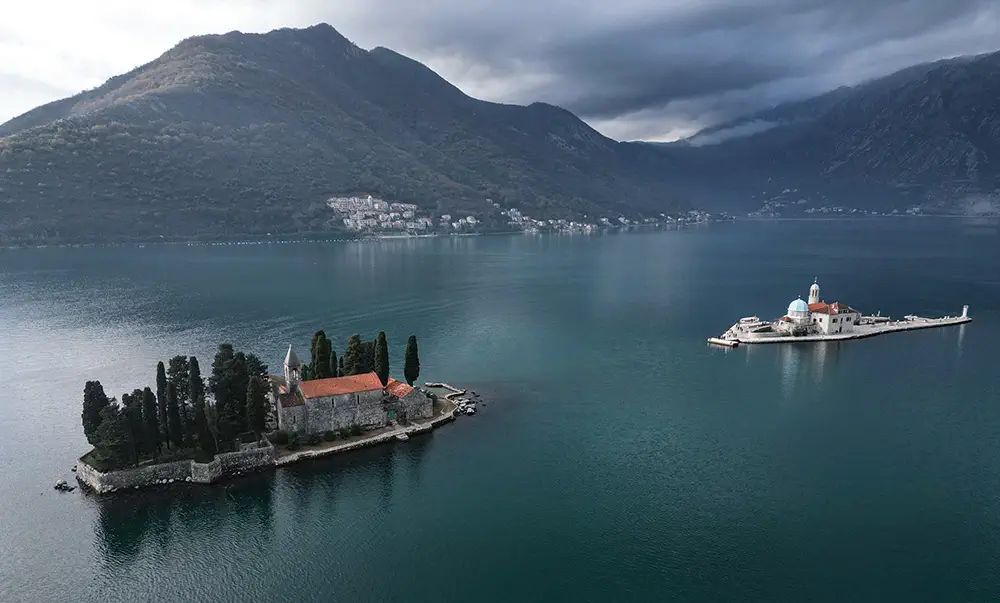
Little remains of that ancient structure. The reason for this is the multiple destructions to which the island's buildings were subjected.
In 1571 the abbey was burnt down by the Calabrian pirate Karadoz the Black-Eyed, and it was not rebuilt until 1603.
On 24 June 1624, Berber pirates already attacked. Not only did they plunder the islands but also the town. They enslaved 415 of the town's inhabitants. Some of them were soon ransomed from slavery and brought home, but the sums were so large that several families were ruined.
As mentioned above, the next robbery took place on May 15, 1654, by Mehmed-pasha Rizvanagic and Bega Aksagic, when an attack was repulsed on the town, but not on the islands near it.
But pirates were not the only ones. On 6 April 1667 the structures on the island were again destroyed to the ground by a catastrophic earthquake. It was at this point that Andrija Zmajevic ministered Holy Mass on the island. He himself miraculously survived, but the collapse of the vaults killed 28 parishioners and many were injured.
The island has changed patron several times in its history, but has never fully belonged to Perast. The fact is that after the decline of Risinium (today's Risan), the inhabitants of Kotor were the first in the gulf to go to sea, while the people of Perast preferred to exist far from the coast in the village of Glogovac. This allowed the Kotorians to build their fortification on the island without any resistance. Subsequently, it was Kotor who had the patronage over the island, despite the disputes and claims of Perast. In 1634, the island was ceded to the Senate of the Republic of Venice. After the fall of Venice, it was occupied by the French, and after them, in 1814, by the Austrians.
For many centuries (until 1866) there was a cemetery on the island, as evidenced by the preserved tombstones with the heraldic symbols of the noble families of Perast and Kotor.
Tourists are now not allowed to enter St George's Island. A special permit must be obtained to visit it.
Perast's noble families
According to chronicles, there were 12 patrician families or «casadas» in Perast, each with its own coat of arms and banner. They had great influence in the town, were elected to the town council and decided many issues of life in Perast.
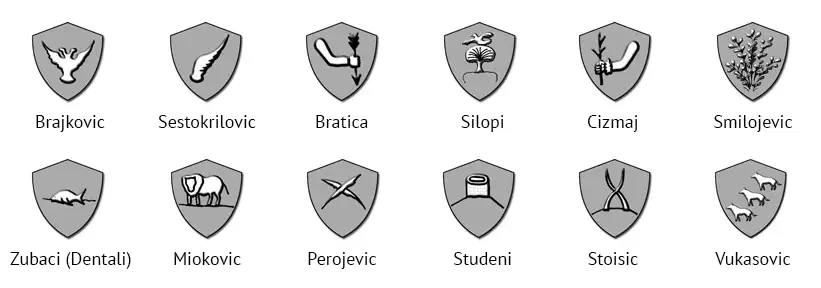
The streets of Perast preserve a number of artefacts and palaces that belonged to one noble family or another:
Dentali
Balović Palace (Palata Balović)
The Balovici family belonged to the Dentali Casada and were mostly sailors, either in the navy or in the private maritime trade. The family is famous for its library with archives, but the first part of them was taken away in 1933 and the second after the end of World War II.
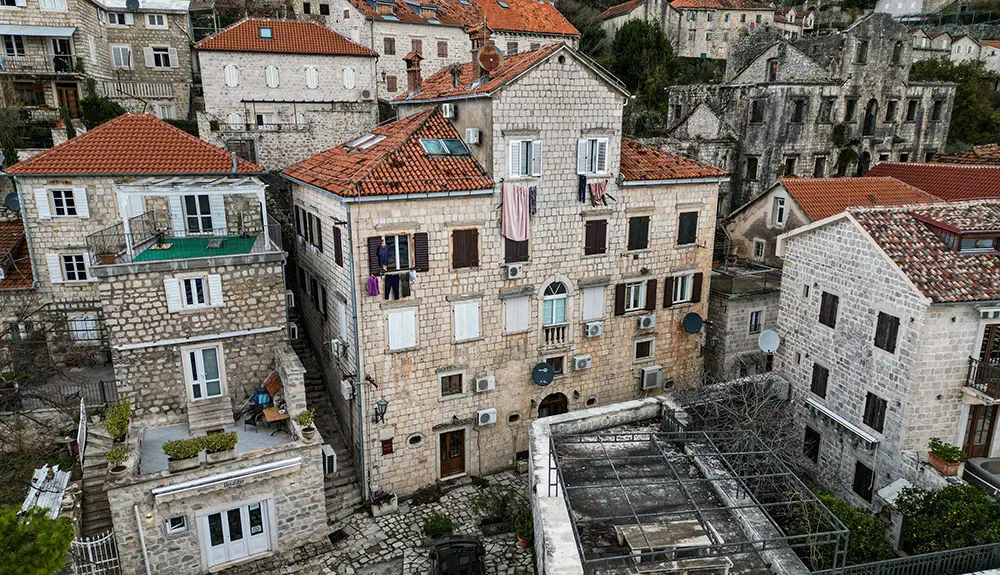
Balović Palace is an 18th-century Baroque building with two floors and a belvedere. It originally had four rooms and a living room, but was converted into apartments in 1981.
It is also famous for being the summer residence of the Prince-Bishop of Montenegro, Bishop Negos, who wrote his works «Paris and Helena» and «A Night More Dear than the Century» in 1846.

Visković Palace (Palata Visković)
Unlike the other palaces, the Visković Palace is an entire complex, consisting of a defence tower, the palace itself, a loggia with a garden and an additional building. The tower is the oldest part, built at the turn of the 15th and 16th centuries, and it retains a cannon on its top. Its door jamb still bears the inscription «Parvum Propugnuculom Pro Praesidio Perasti» (as it was called at the time). Next to it are the rest of the buildings.
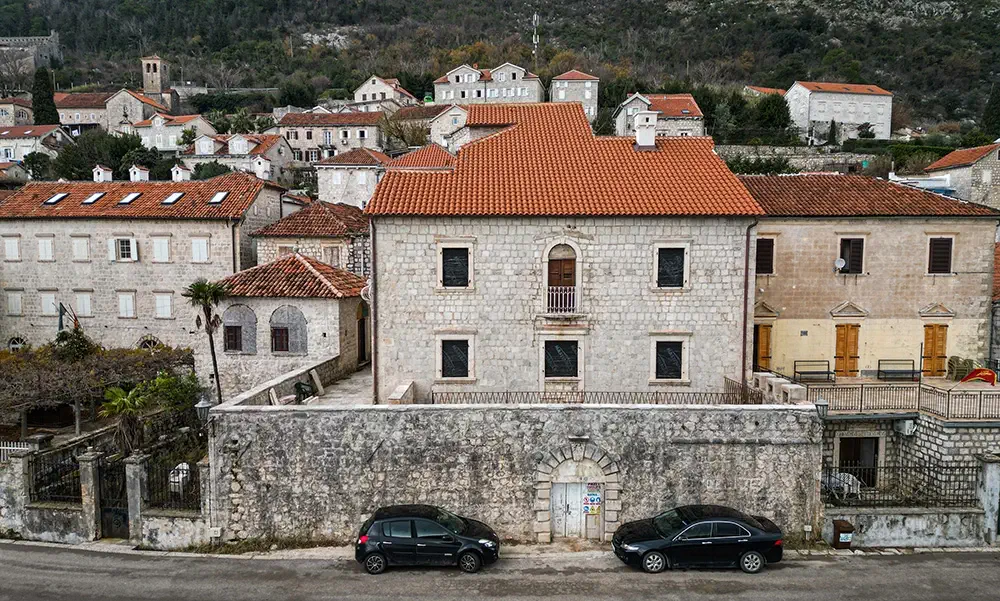
The palace has three rusticated entrances:
- in the southern part by the garden, facing the sea. This entrance is decorated with a coat of arms with a toothy fish in the upper part - the heraldry of the Dentali family, to which the Viskovic's belonged. The lower part of the coat of arms depicts a lion, which is already characteristic of the Visković family.
- In the north-eastern part of the palace is the main entrance. The coat of arms with fish and the initials FCCV (Francesco Conte Colonello Visković) can also be found here).
- The same part has an entrance on the loggia side. Like the previous two, the entrance is decorated with a coat of arms depicting a fish. Here you can also find the year of construction, 1718.
Visković Palace is located in the Luka district, near the old road.
Perojević
Zmajević Palace (Zmajević Palace)
It can be found in the Prenčići district, which is located in the western part of Perast. It received its other name, «bishop's», as it was home to two bishops, Andrija Zmajević and Vicko Zmajević. The Zmajevićs were part of the Perojević family and their family coat of arms shows a winged dragon and a star in the upper part and crossed knives — the symbol of the Perojevićs — in the lower part.
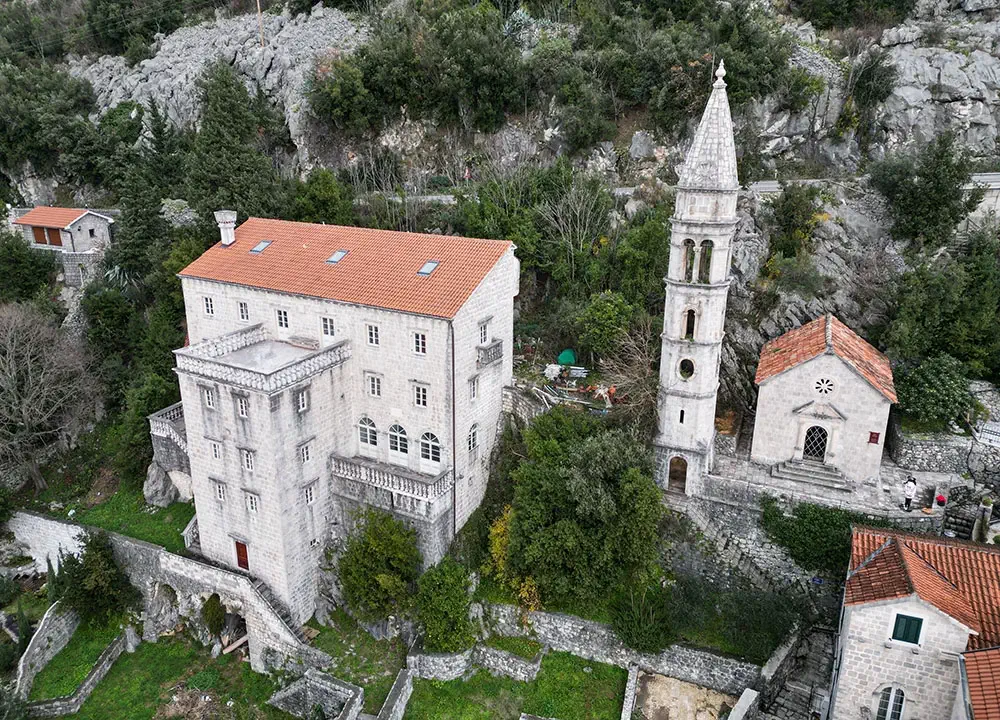
The palace was built in 1664 from local stone. In 1678, an octagonal bell tower with a chapel dedicated to Our Lady of the Rosary was erected here to serve as a mausoleum for Andrija Zmajevic. This bell tower is considered to be one of the most beautiful on the coast.

Previously this palace also housed one of the largest libraries in Dalmatia.
Silopi
Bronza Palace (Palata Bronza)
The Bronza family moved to Perast from Shkoder, Albania and belonged to the Silopi family. Its members were famous sailors and merchants.
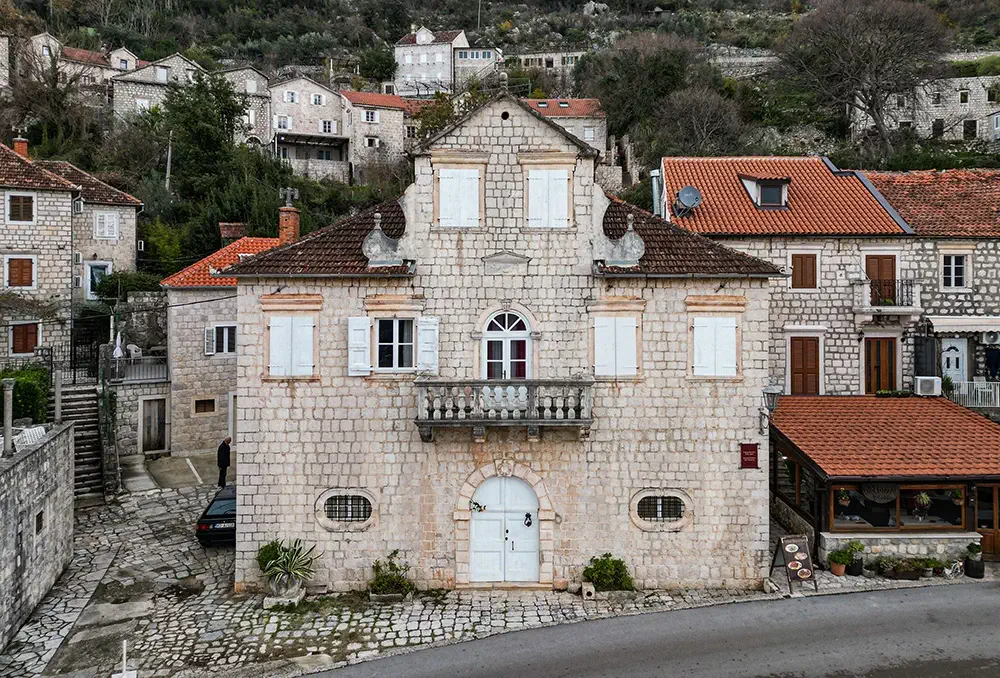
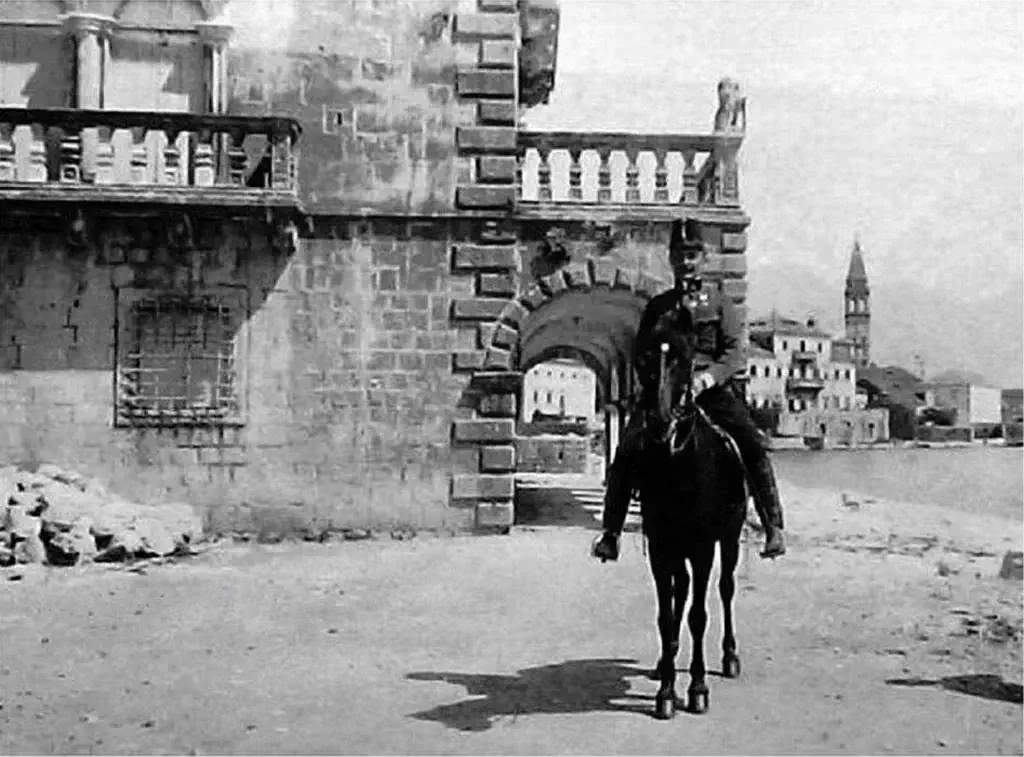
Their palace is situated on the seafront in the Luka district in the eastern part of Perast. It was built in the middle of the 18th century. In the 19th century, during the Austro-Hungarian rule, the palace was turned into a customs office. It is a typical one-storey building with a Baroque gazebo. Today, the original layout of the rooms has been preserved.
Stojišić
Bujović Palace (Palata Bujović)
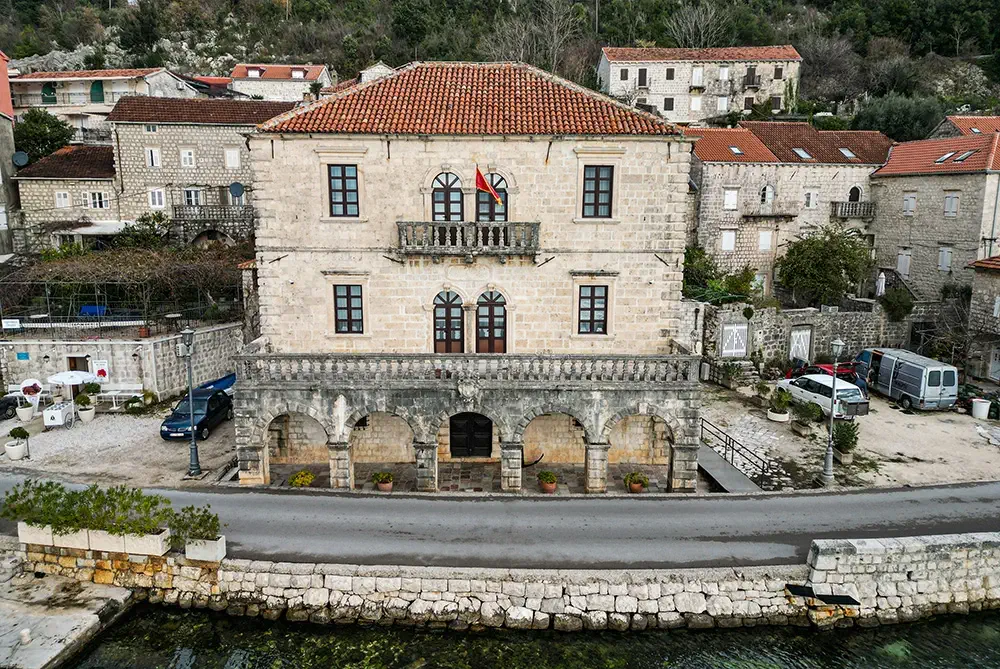
Located by the seafront, in the western part of Perast. It was built of hewn stone taken from the ruined walls of Herceg Novi after the Turks were knocked out of it in 1687. The building was laid in 1694, financed by the authorities of the Republic of Venice, in gratitude to Vicko and Ivan Bujović for their contribution to the battle.
The building was designed by the Venetian Giovanni Battista Fontana. The palace was designed in the Renaissance style, the columns of the monumental arcaded portico are rusticated. A large porch runs along the entire length of the ground floor, topped by a balustrade terrace. This is one of the most beautiful buildings on the Adriatic coast. Today it houses the Perast Museum.
Studeni
Lučić-Kolović-Maticola Palace (Palata Lučić-Kolović-Matikola)

Located in the western part of the city along the promenade. It was built in the second half of the 18th century (1779). A record of this can be found on the facade of the building. It also lists the names of the owners: Nikola Kolović-Matikola and members of the Studeni family. A distinctive feature of this palace is the belvedere on four sides.
Čizmaj
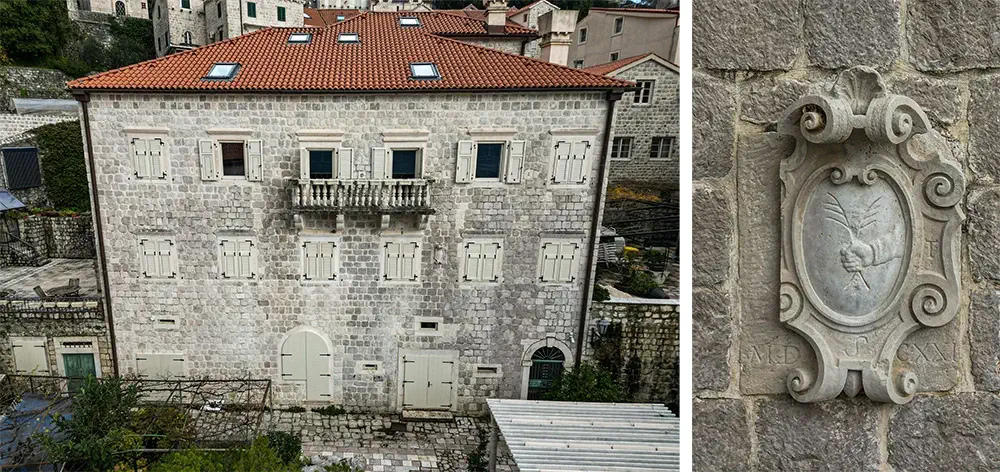
Brajković-Martinović Palace (Palata Brajković-Martinović)

Located west of the main square next to the old road, the Brajkovic-Martinovic Palace is one of the oldest preserved palaces in Perast, built on the site of the old Markovic family house. The year 1623 is mentioned in the town records as the year of its construction. The palace was built by Vicko and his brothers, the sons of Tripo Marković — later known as Martinović — of the Čizmaj family. Remarkably, the palace has retained its original plan. The interior of the first floor was designed in the late 19th century in the Napoleon III style. It is the only fully preserved interior in Perast, with original decorations and furniture.
Smekja Palace (Palata Smekija (Smkija))
The palace consists of two structures connected by a vaulted passage over the old road. It is the largest palace in Perast. The three-storey building with a belvedere is built entirely from stone imported from the island of Korcula, Croatia. A terraced porch stretches along the entire length of the ground floor, and the second and third floors are decorated with balconies with balustrades. Above the entrance is the coat of arms of the Čizmaj kasada — two crossed branches with five feathers on each.
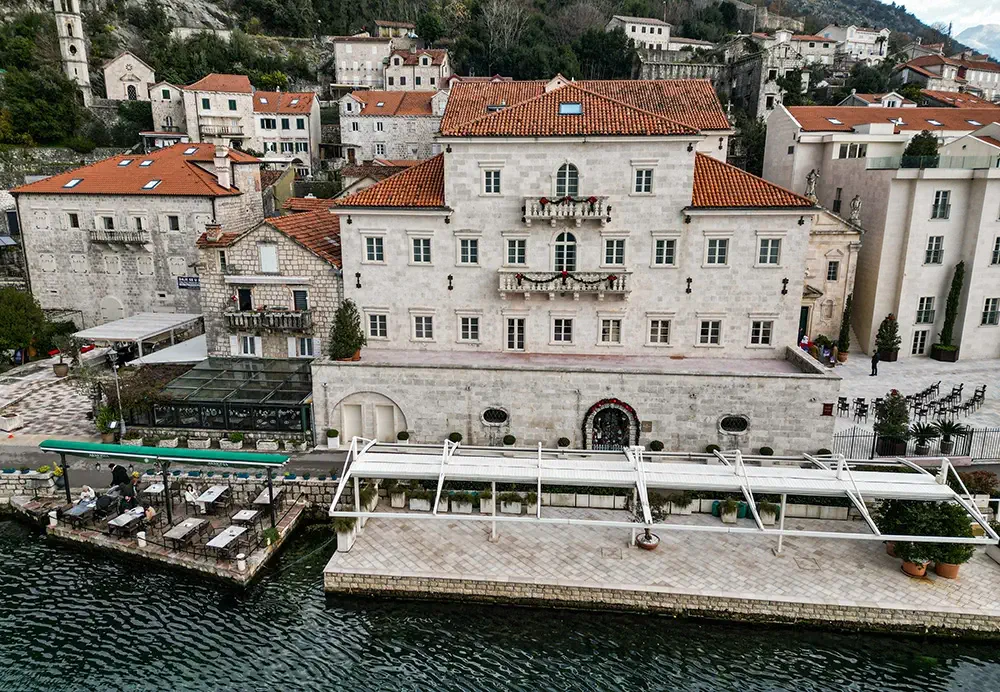
It is known that members of the Smekja family were sailors. The first mentions of this date back to the first half of the 16th century. However, the family achieved its greatest recognition in 1746, when Petar Smekja established a trade route between the Baltic States and the Republic of Venice. For this he received the rank of count in 1748 and in 1749 his family acquired the status of nobility in Kotor.
The palace is situated in the central part of Perast, next to the church and St Mark's Square. It is noteworthy that the first part of the building, located between the coastal road and the old road, was built in 1764. The second part began to be built here in 1764, but was not completed until the 1930s.
Šestokrilović
Šestokrilović Palace (Palata Šestokrilović)

Located in the Luka district, in the south-eastern part of Perast. As stated on the building, it was built at the end of the 17th century in 1691. The Šestokrilovići were one of the oldest families. Their palace is a two-storey building without a belvedere, reminiscent of the Renaissance style. It has a hipped roof with a characteristic hip roof. The palace has a hipped roof with distinctive embrasures.
Vukasović-Kolović Palace (Palata Vukasović-Kolović)
The Kolovici belonged to the family of the Šestokrilović. They came to Perast from Sestanj, a settlement near Bar. In the 17th and 18th centuries they became known as sailors and merchants. They also practised medicine, theology and literature.

Their palace is located in the Luka district, next to the Visković Palace, on the seafront. The approximate time of construction is the first half of the 18th century.
Museums in Perast
Perast Museum
In 1937 the Perast Municipal Council decided to establish the city museum. Initially it was located in the municipality building, but in 1957 it was moved to the Bujović Palace.

The museum has a collection of portraits of famous Perast seafarers, weapons and everyday items from the town's past. It also houses the town's archives, which date back to 1441. The museum exhibition traces the life of the town from the Venetian era to the reign of the French and then Austria-Hungary.
Museum of Perast. Working hours in 2024
From 15 October to 15 April.
Tuesday - Sunday from 10.00 a.m. to 4.00 p.m.
From 15 April to 15 October
Tuesday - Sunday from 8.00 to 20.00.
Museum of Perast. Admission fees in 2024
- Individual entrance ticket — 5,00€
- Guide service — 15,00€
- Entrance ticket for children under 18 and students with a valid ID — 3,00€
- Entrance ticket for group visits (more than 10 people) — 3,00€
St Nicholas Church Museum
As you can easily guess, it is located in the Church of St Nicholas in the centre of Perast, on the main square. This cathedral was built in 1616 on the site of what is believed to be an earlier building from 1564.

It was here, next to the Church of St. Nicholas, that the tallest bell tower on the entire East Adriatic coast was built in 1691 by the architect Ivan Skarp of Hvar. The main bell was set up in 1713 — a gift from Bishops Andrija and Matija Zmajevic. The clock for the bell tower was made in Venice in 1730. Two more small bells were added here in 1797.
The cathedral itself contains a collection of relics, silver and wooden crosses, chalices, icons, Baroque paintings by Tripo Kokol (1661-1713), as well as other valuables and precious vestments. An organ may be an equally interesting element for the visitor. Unfortunately, the exact date of its creation has not been preserved, but the first mention of its repair is dated 1699.
Additionally. You can also highlight the museum in the Church of Our Lady of the Rocks. You can find out more about it at the link.
Perast fortifications
In addition to the fortifications on the islands of Perast, as well as the complex of fortifications around the Church of Our Lady of Angels, which helped control the entrance to the Bay of Kotor through the Verige Strait, Perast had a number of fortifications directly within the city limits. As mentioned above, due to the terrain, city walls were never built around Perast. Instead, the town used 10 watchtowers, also called kardaks, and a fort in the northern part — the Fortress of the Saint Cross.
The very first tower — Marković Tower — was built in the early 16th century on St. Nicholas Square. It later became known as the Martinović Tower. The last of the 10 towers was built in 1656.
Today, only Matosevic tower survives. The towers of Zvecan, Krsticevic, Hercegovic, Burovic and Mare Krilove were destroyed.
Each of the towers was built on a small square foundation. These were two-storey buildings that had either a vaulted or wooden ceiling with their own cisterns for water in case of a siege. The roofs were usually single-pitched.
Perast traditions
On 15 May, Perast celebrates the victory over the Ottoman troops (15 May 1654). On this day, a traditional rooster-shooting competition is held — «Peraska Gospa», where the bird symbolises the enemy. The competition involves the use of an air gun and the participants attempt to shoot at a rooster on a raft a few hundred metres from the shore. The shooter who hits the target is awarded a «sugaman» (towel) on which the dates of the shooting and the battle are embroidered. The winner is obliged to treat the whole town to a barrel of wine.
Fasinada is a custom that is more than 500 years old. On 22 July every year, residents drop stones into the foundation of their man-made island, the Gospa od Skrpjela. In addition to tradition, this also helps to keep the island from eroding.
The International Klapa Festival (a form of traditional a cappella singing in Dalmatia) is held on the second weekend in August. It brings together klapas (traditional groups) from the Mediterranean countries. It is the only Klapa festival in Montenegro.
Perast cuisine
A speciality in Perast is bobi. It is a traditional sweet made at religious carnivals. Its recipe is carefully preserved by the town. Other settlements along the bay make doughnuts, but in Perast «bobi» are fried.
Another famous Perast dish is almond cake. In local coffee shops and restaurants, it is so called «Peraška torta» or «Perast cake». You can try this dessert only in Perast; you will not find it anywhere else on the coast.
How to get to Perast
Depending on your departure point, there are different options for how to get to Perast. The easiest and most reliable option was and still is to travel in your own or rented car. As a rule, parking is paid only during the summer period (approximately from April to October). The rest of the time parking is free of charge.
If you plan to visit during the summer, the prices in 2023 were as follows:
- Car — 8€ per day or 15€ for 24 hours
- Minibus (up to 15 people) — 12€ per hour (!) or 30€ for 24 hours
- Bus — 25€ per hour
If this option is not available, intercity buses, which run fairly regularly from almost anywhere in Montenegro, can help.
Getting to Perast from Kotor
In addition to the car and taxi, there is also a «delivery option» from Kotor by boat. This way you can both enjoy the beautiful views and be guaranteed to reach Perast without the traffic jams that are especially common in the summertime. Just walk up to the many boats along the beach in front of the old town and ask for a price. If it suits you, take advantage of this opportunity.
As for buses, unlike the rest of Montenegro, there are two types of buses from Kotor to Perast.
1. Standard intercity bus
Its timetable can be viewed on busticket4.me.
You can check the timetable in advance and arrive at the station at the right time. However, it is better to buy your tickets at the bus station for two reasons:
- A ticket bought online will still have to be printed out somewhere. A PDF version on a smartphone is generally not accepted.
- You will be able to find out if a particular bus goes through Risan. The fact is that some buses (although there are only a few of them) go through the ferry and therefore do not pass through Risan.
So the recommendation is as follows: come to the bus station 15-20 minutes before the scheduled time of departure and ask for a ticket to Perast. The bus station employee will take care of the rest.
When planning your return trip, look for buses from Herceg Novi to Kotor. And add about 40-50 mins to departure time from Herceg Novi. Or just take any bus towards Kotor.
2. Blue Line municipal bus
In brief, it is a local municipal transport service. It is important to note that due to traffic congestion, its timetable is approximate. You can check the timetable either at the bus stop (a timetable sheet is often displayed at the bus stop itself) or on the website.
Getting to Perast from Herceg Novi
The situation is almost identical to that for Kotor. The bus timetable can be found on busticket4.me.
You can check the timetable in advance and arrive at the bus station at the right time.
When planning your return trip, look for buses from Kotor to Herceg Novi. And add about 30-40 mins to the departure time from Kotor. Or just take any bus towards Herceg Novi.
Getting to Perast from Podgorica
The buses you need leave from the bus station. The right ones for you are those on the Podgorica-Herceg Novi route. You can see the bus timetable on busticket4.me.
Getting to Perast from Tivat, Budva and the rest of the coast
Bus station locations on Google Maps:
- Tivat Bus Station. You can also read a detailed description of how to get from Tivat to different cities in Montenegro here.
- Budva Bus Station
- Bar Bus Station
- Ulcinj Bus Station
For an approximate bus timetable visit busticket4.me. During the summer, buses can be late due to traffic jams, so it is worth taking this into account.
The second important thing to keep in mind is that some buses (although there are only a few of them) go through the ferry and therefore do not pass Perast. For example, such carriers usually include Elite Express. So when buying a ticket at the bus station ticket office ask for the ticket to Risan. This will avoid unpleasant situations.
