
Fort Vrmac (Werk Vermac in Austrian sources) is a former 19th century Austro-Hungarian fortification. The fortress is situated 475 metres above sea level on the Vrmac mountain range between Tivat and Kotor.
Fort Vrmac is one of several defensive buildings whose mission was to defend the Bay of Kotor from the east. In addition to it, the complex of defensive structures also included Gorazda, Trinity and several defensive batteries.


Building Description
Fort Vrmac is a three-storey fortress, which was erected in stone and concrete. It is surrounded by a moat about 7-8 metres wide and 5-6 metres deep. Along the moat, there were two lateral caponiers which could carry flanking (longitudinal) fire. A third caponier, the rear one, was responsible for the safety of the entrance to the fortress.

All the guns were pointed towards Kotor, Tivat, and the bay. This is due to the fact that the fortress was designed to defend these very sites.
The fortress housed up to 177 soldiers and 5 officers.
The lowest level of the fortress is the basement, which is one large cistern for collecting rainwater.
The ground floor housed barracks, toilets, showers and ammunition stores.
On the first floor there were four casemates with 10cm Škoda cannons, as well as several defended ammunition rooms. Each casemate gun was housed in a bunker, which was supposed to provide cover from enemy fire. Only the cannon barrel protruded through a small opening to the outside. The whole installation could swivel to the right and left and tilt up and down.
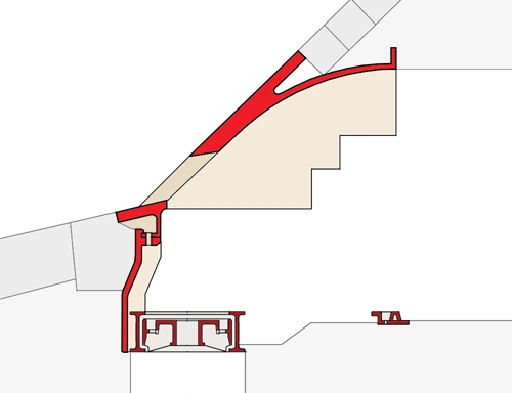

On the second floor were eight M80/85 15 cm mortars with a range of 3-4 km. Their task was to cover Kotor, part of the Župa plain and the Vrmac mountain range.


A motorised lift was installed in the fortress to bring ammunition and various guns up to the upper floors.


Building History
Fort Vrmac was first mentioned in 1860 (1858 according to Montenegrin data). It was an excellent location for controlling the surrounding areas. This position overlooks Kotor to the east, the Trinity Pass leading to Kotor from the south and the Župa valley to the west.
The Krivošije Tribe uprisings of 1869
The Krivosije tribe, who lived on the eastern slopes of Mount Orien above Risan, were quite powerful. Ever since the Venetian rule of Boka, the Krivosije have had autonomy and the right to bear arms. However, in 1868 the Wehrgesetz (Defence Law) required that the tribes of Krivoši also be subject to military service. The law also required the surrender of all weapons in the possession of the population.
The Krivosije tribe did not want to say goodbye to their age-old traditions and rights, so the first rebellion began. A rebel committee was formed which issued a proclamation: «The enemies have trampled our rights… rise up chivalrous Boka Kotor, falcon's nest in the fir mountains… Go to the bright battle for freedom!»
Around the same time Montenegro, with the help of its Russian allies, intended to regain control of Kotor. So when the Austro-Hungarian Empire tried to suppress the uprising, compatriots from independent Montenegro and Ottoman Herzegovina came to the rescue and helped defeat the Austrians.
A compromise peace was reached on 11 January 1870 in the village of Knezlaz. As a symbolic act of agreement, the rebels laid down their arms on the ground, but retook them afterwards.
Already in 1881, after Bosnia and Herzegovina joined the Austro-Hungarian Empire, the situation repeated itself. The government once again obliged the Krivoša clan to conscription and ordered them to lay down their arms, after which a second uprising started, which quickly spread to other regions. Only in 1882, the Austrians managed to suppress it.
In 1887 the fort was still a «temporary fortification» and full-scale construction began in 1894.
Construction of 1894-1897
Although Austria-Hungary managed to regain control of the Bay of Kotor in 1882, the authorities were aware of the remaining danger from Montenegro.
In parallel to the additional reinforcements, the Austro-Hungarian State Fortification Commission decided to enlarge and improve the Vrmac Fort. Therefore, in 1894-1897 it underwent an extensive reconstruction and enlargement. The fort became bigger and it was equipped with a lot of modern guns: four steel domes with 10-cm PH M05 guns in each, eight 15-cm MinSchKan M 80/85 howitzers in casemates and twelve machine-gun mounts on the roof.
After this improvement, Fort Vrmac became one of the most modern in its region at that time. It replaced the Trinity and Kavací forts, which were now considered obsolete, and dominated the entire bay along with the Gorazda fort and the Škaljari battery.
The fortress in 1905-1916
The Vrmac fort was the strongest fort for a short time. Already in 1905, the Montenegrin army received new weapons — light and medium rifled guns, for which the Vrmac Fortress was easily accessible. However, only 10 years after the last improvement, Vrmac was again subjected to expansion.
The fortress was reformatted into a long-range battery. In 1906-1907, the field guns were removed from the roof and its strength was increased — the ceiling was now 1.5 metres thick.
However, despite all the renovations and upgrades, by 1910 the Vrmac fort was again considered outdated, as even the mobile artillery at that time already had much larger calibres. Therefore there were plans to build a new fort, «Hohen Vermac», on the highest point of the mountain range, the peak of St. Ilija. But the plan never materialised, as the Sarajevo murdery soon followed by the World War I.
Fort Vrmac during World War I
Truly difficult times for the fort were 1914-1915. Massive shelling by the Montenegrin army hit the fort in 1914. As a result of one of the attacks, an ammunition depot exploded and the fort was badly damaged. Only thanks to the military reinforcements that arrived to help, the fort was able to hold out.
The fort was rebuilt in 1916, but the guns were dismantled and reused elsewhere.
Fort Vrmac after World War I
After the end of World War I, the Bay of Kotor, and with it Fort Vrmac, became part of the Kingdom of Yugoslavia. During World War II, the fort was occupied by Italy, but was later returned to the Socialist Federal Republic of Yugoslavia.
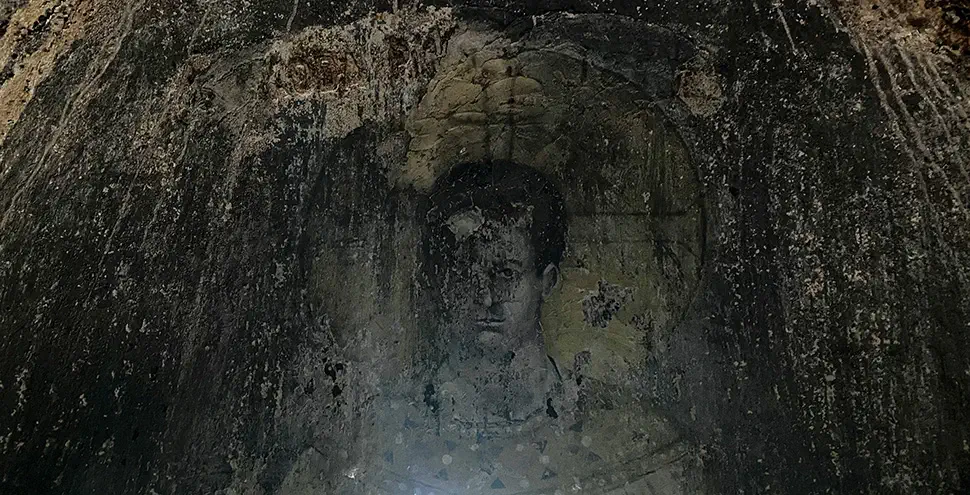
Over time the fort became abandoned. The story goes that a hermit monk settled there and turned one of the mortar casemates into a prayer room. The frescoes are barely visible, but still some icons of saints can be discerned.
At the moment the entrance to the fortress is free and it attracts a large number of camping tourists every year.
Cold War-era shelters
Not far from Vrmac Fort, you can stumble across Cold War-era Yugoslav tunnels that stretch deep into the mountain and emerge on the other side of it. Most of them have long been buried and destroyed, only occasional shapes of underground structures can be seen. However, there is a shelter that survives.
It is not easy to find, one entrance is along the road, but it is covered by rocks and bushes, while the opposite entrance is in the middle of the forest.
There is also a third way to get inside: there is a steel machine gun bunker on the mountain above the road, which can be accessed through a hatch. Once down, you will find yourself in a small corridor that connects the actual room of the pillbox and the descent deep into the tunnels, which is implemented with staples.


On the lower level, in addition to the tunnels connecting the three exits, you will also find several utility rooms, a kitchen, barracks and showers.


How to get to Vrmac Fort
There are several ways to get to Vrmac Fortress:
- By your own or rented ca;
- On foot, starting from the village of Muo;
The coordinates of the fortress:

By Car
The most convenient way to get to Vrmac Fort is to drive up the serpentine road from Tivat. The road leading to the fort was paved by Austrian soldiers in 1882, but unlike other Austrian mountain roads, this one has been repaired, modernised and is now paved.
On foot
If you are staying in Kotor, you can climb the fortress on foot along a trail that was built back in 1860. The trail starts at the village of Muo. It is worth noting that the current condition of the trail is rather poor, sometimes there are fallen rocks or fallen pines, but it makes up for it with a stunning view of the Bay of Kotor.
