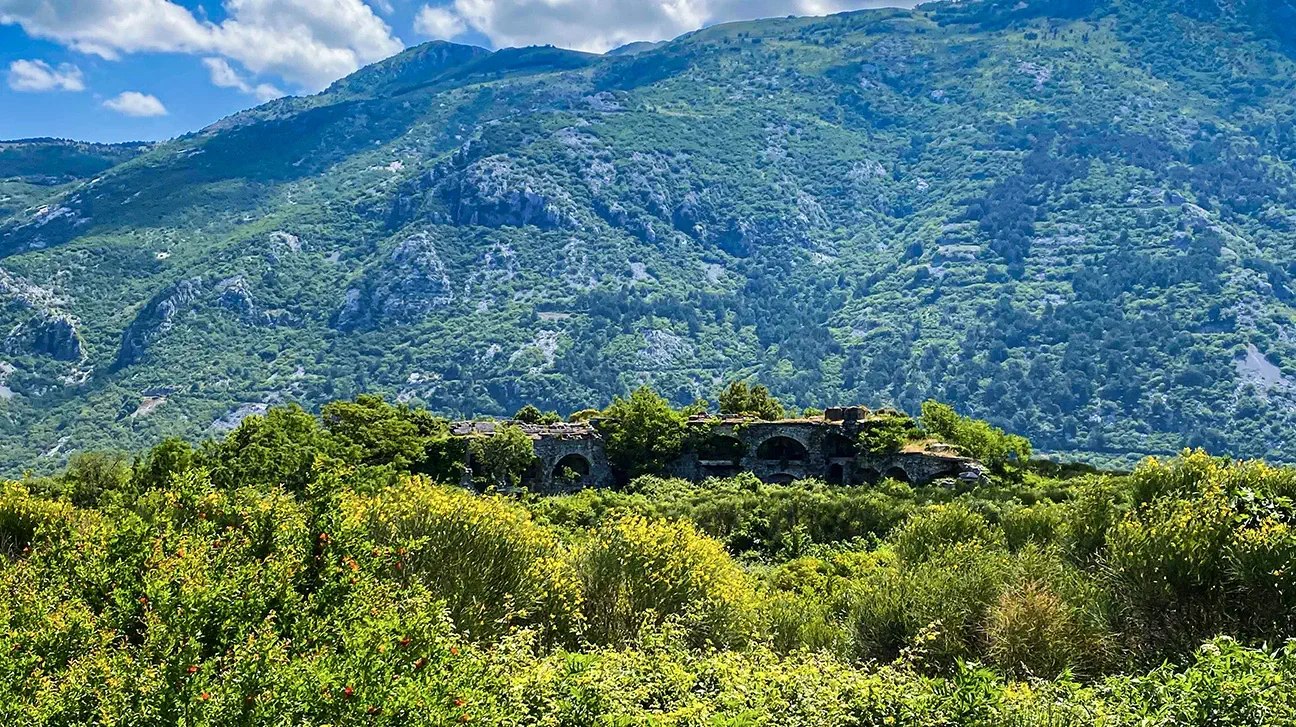
The Škaljari battery is situated on the eastern side of the Vrmac mountain range, 410 meters above sea level and only one and a half kilometers from the Gorazda fort.
It can be said they were inseparable parts as they controlled each other's blind spots, thus preventing the enemy from being unnoticed.

The main task of the Škaljari battery was to control Montenegrin artillery on Mount Lovćen, on the Krstač-Kuk-Zalazi line. It was also to control the mountain serpentine leading from Kotor to Cetinje.
The outer combat side of the fortress was concealed by an earthen berm and the muzzles of the guns looked out almost out of the mountain. This design gave the battery stealth and the ability to remain out of the enemy's sight for some time.
Building history
The first building on the site of the Škaljāri Battery was erected as early as 1860 and was called «Battery B». It was considered a semi-permanent fortification, so it is not surprising that a new one was soon erected in its place.
The second building was completed in 1878, but was of no importance, rather being considered a reserve structure in case the enemy attacked.
However, after the Kotor-Cetinje road was built in 1884 the decision was made to build a new defense battery in place of the former ones. At first, the battery was called «Battery Vrmac», but soon, to avoid confusion with the fort «Vrmac», it was renamed Battery Škaljari.

Škaljari's battery armament
Initially, the Škaljari Battery was considered a purely artillery fortification. The main guns were four 12cm M.80 Minimalschartenkanonen guns. These guns were housed in two Austrian-made Witzkowitz armored semi-batteries. There, two 12-cm M.61 Kasemattkanonen guns were installed in stone casemates. In addition, the battery had twenty gun carriers for Gewehrlafetten rifles and machine guns.

In 1896-1897 the battery succumbed to modernisation: two splinter-proof observation posts were built. In 1907 a permanent wire fence was installed and a second earth mound was built.
At the time of 1914, the complete armament of the fortress was:
- Four 12cm M.80 Minimalschartenkanonen;
- Two 9cm M.4 Kasemattkanonen;
- One 8 cm M. 94 Kasemattkanone;
- 20 Gewehrlafetten rifle and machine gun carriages.
Despite these improvements, the battery's defensive capabilities over time ceased to meet modern standards and became obsolete.
This was confirmed in 1914 by the first bombardments from Montenegro.
In 1915 the Škaljari Battery was disarmed, after which it was only used as an infantry base.


At the end of the First World War, the Škaljari became used as a «quarry». The brick walls and masonry of the outer walls were dismantled.
As a result, the Škaljari battery is now in a severely dilapidated state. In addition, it is almost inaccessible, as the surrounding area is a landfill overgrown with tall bushes.

How to get to Škaljari Battery
The only way to get close to the remnants of the battery is to drive a part of it and then walk.
At the second curve of the serpentine road to Fort Vrmac, you will see a gravel road that branches off from the main road. As you pass, or better still, walk along it, you will see the remains of a battery on your left.
The point of the road junction:
